Ark of the Covenant Summary
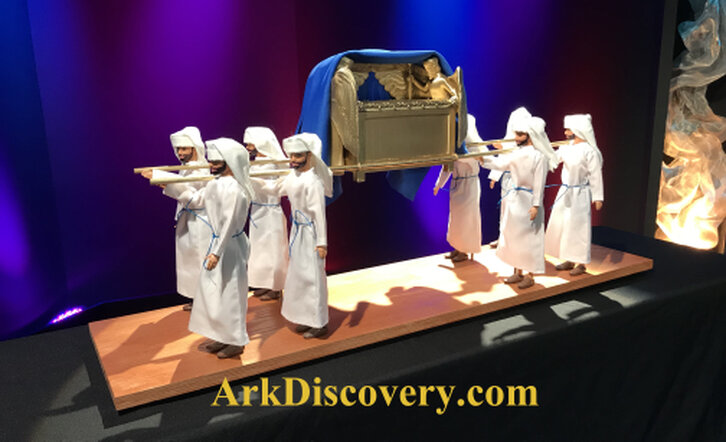
We explore the details about Ron Wyatt finding the resting place of the Ark of the Covenant just outside the old city of Jerusalem in a cave. The Babylonian army in 586 BC had surrounded the city and Jeremiah and his men hid the ark and the other temple furnishings in that cave for safe keeping. God assisted Mr. Wyatt in relocating the ark for the people of earth to hear about soon.

Ron Wyatt was at the Red Sea crossing at Nuweiba, Egypt and located a chariot wheel in the waters there. He then headed north to Jerusalem to prepare to fly out via Tel Aviv for his trip home. He was inspired to visit the Garden Tomb grounds where our dear Jesus was buried. While at the site he struck up a conversation with a representative from the Israeli Antiquities Authority. Ron told him about the Noah's ark site and the chariot wheel he had found, so the official offered Ron to look around the garden area. While in the back of the garden area toward skull hill, God raised his arm and He put these words in Ron's voice, "There is Jeremiah's Grotto and the Ark of the Covenant is in there." Ron hadn't even thought of those words, but they came out through God's direction. The official with Mr. Wyatt said that was wonderful to hear, and he would give Ron a place to stay, and food to eat while working on the site. This was puzzling to Ron because he had not even thought about the Ark, and yet God spoke through him with those words. The site was unassuming, just a trash pile next to a rock escarpment, and not appearing to be the area for the earthly throne of God. First, Ron had to return to the states and begin research on the idea of the Ark even being in that location. Over the next three years he worked at the site, making 11 trips there, and on January 6, 1982, Ron entered the chamber that contained the Ark of the Covenant.

3 new programs on the discovery of the Ark of the Covenant from Shabbat Night Live studios:
Link to purchase DVD from A Rood Awakening: www.tinyurl.com/arkcovkevinfisher
December 2023 Interview with Pastor AJ on Ark of the Covenant topic
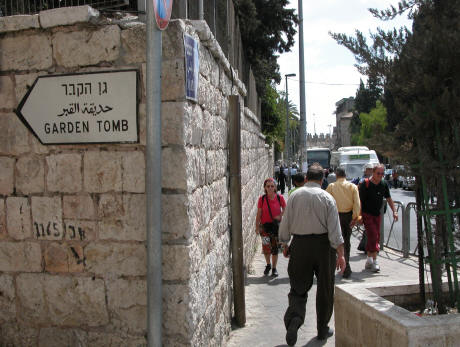
Turn left up this alley to the Garden Tomb grounds. In the distance you can see the old city walls of Jerusalem.
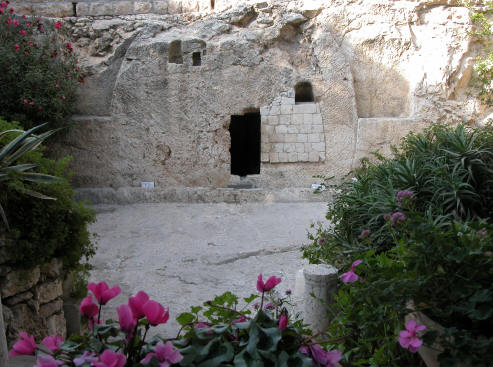
Before we begin studying about the discovery of the Ark, let's take a look at the beautiful area which is the backdrop of the discovery. It is part of Mount Moriah where Abraham was to sacrifice Isaac. The Garden Tomb area is along an escarpment north of the city wall of Jerusalem, and is a tourist spot frequented by thousands of people each year. It is owned and maintained by the Garden Tomb Association in London and was acquired by them in 1894. It had been speculated, and then confirmed in Ron Wyatt's excavations, that this is the authentic burial site of Christ. Just to the east 130 yards is the formation Golgotha "the place of the skull" as mentioned in the New Testament. Between the tomb and skull hill is the actual crucifixion site of Christ, and the Ark of the Covenant is in a cave below that spot!
The location of the Garden Tomb is north of the old city of Jerusalem about 100 yards. The temple sacrifices were to always take place north of the tabernacle as required in Levitical law. Also, in the New Testament it states, "The place where Jesus was crucified was near the city." John 19:20. Golgotha or Calvary is in close proximity to the Damascus gate on the north side of Jerusalem near the Garden Tomb.
John 19:41,42 "Now in the place where He was crucified there was a garden, and in the garden a new tomb in which no one had yet been laid. So there they laid Jesus, because of the Jews' Preparation Day, for the tomb was nearby." There are several elements in this area which give credibility to this site matching the verse above. First, the tomb itself, second, an ancient underground water cistern that facilitated a garden area, and third, a large winepress, and fourth, the place of the skull.
The Tomb
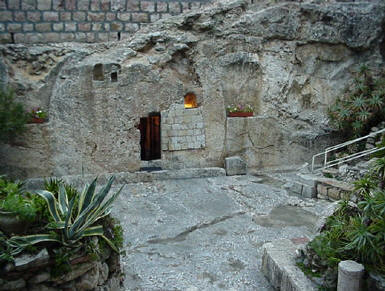
Matt. 27:59, 60 "And when Joseph had taken the body, he wrapped it in a clean linen cloth, and laid it in his new tomb which he had hewn out of the rock. and he rolled a large stone against the door of the tomb, and departed." Notice in the photo above, the arched radius to the left of the entrance. This follows the contour of the 13 foot tall rolling stone ("...it was very large." Mark 16:4) that sealed the tomb. The rolling stone was probably cut out of the face of the tomb. When the stone was in place to seal the tomb, it covered a small window to the right of the entrance. When the stone is rolled back, this opened the window allowing light to enter the tomb. To the right of the door is a large block that was used to stop the stone from rolling further to the right, and is in a downhill direction. Luke 23:53 also says the tomb was hewn from stone, just like this one.
Diagram of the Tomb
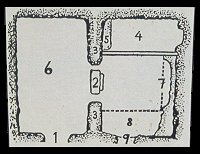
1. Tomb entrance 2. Low threshold to the graves chamber
3. Low walls separating the chambers 4. Burial place of Christ
5. Headrest cut in rock 6. Weeping chamber
7. Rough ledge 8. Unfinished shelf where bones would have been kept, but never were here.
9. Small window
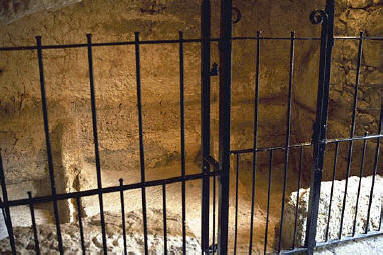
(Above) Looking from weeping chamber into tomb area, we see the probable burial place of Christ on our far left and shown below.
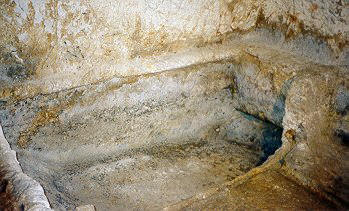
(Above) This is the burial place of Christ and you will notice the foot area at right that was enlarged to accommodate Christ's feet, as he must have been taller than Joseph of Arimathea who had the tomb constructed for himself and was apparently 5' 8" tall. The length of this area is 6 ft 4 inches. The cutting of the stone was hastily completed in order to accomplish the task of burial before the Sabbath hours, Friday at sunset. Mark 16:5 says Mary saw a young man or angel sitting on right side of tomb the first day of the week. He may have been sitting in the right hand portion of this photo.
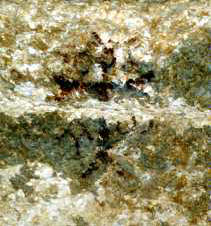
Ancient red cross on wall inside tomb with Greek alpha and omega letters.
White cross outside the tomb. Crossbar near top.
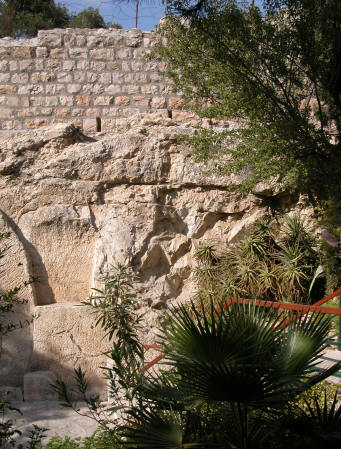
Above: large cross carved in rock face to the right of the tomb. Apparently defaced at some point.
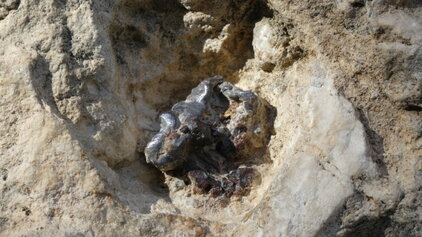
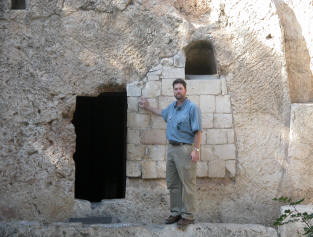
"Make it as secure as you know how. So they went and made the tomb secure, sealing the stone and setting the guard." Matt. 27:65,66 Close-up photo at left is of an iron shaft driven into the rock to seal the stone from being rolled back and opening the tomb. It is about 5.5 feet to the left of the door opening. This would have prevented the stone from being rolled backward. The distance from the iron shaft to the stopping point at right is 13 ft. 2 inches, per our measurements.
"And they made His grave with the wicked-- but with the rich at His death" Isaiah 53:9.
This text describes the other underground tombs to the left of this one where wealthy and wicked men were buried.
This text describes the other underground tombs to the left of this one where wealthy and wicked men were buried.
The Cistern
Near the tomb itself is an underground, 250,000 gallon, ancient rain water cistern hewn out of solid rock. It is the third largest in Jerusalem, measuring 29' wide x 65' long x 30' tall. A cistern this size would be designed to supply water for a large garden, matching the biblical record of a garden area.
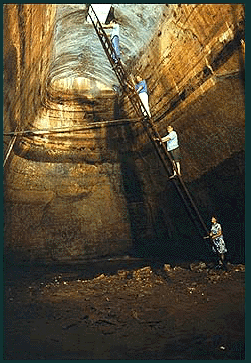
The evidence shows this cistern was built prior to the time of Christ, but it does contain two crusader style crosses that were added at a later date when repairs were made. There probably was a large olive tree grove and a vineyard in the garden which benefited from this cistern.
The Winepress
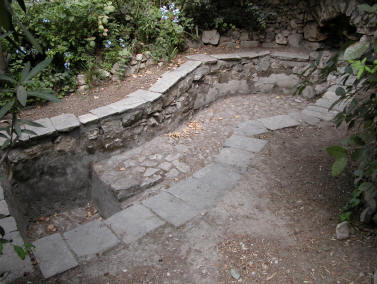
Sixty feet in front of the tomb is an ancient wine press (above) which was excavated in 1924, is one of the largest in Israel. It is thought to be of pre-Christian origin. A very large vineyard must have been in the area for a press this size to have been in use.
Golgotha - The Place of the Skull
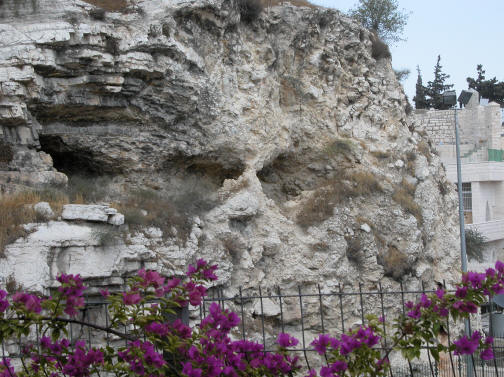
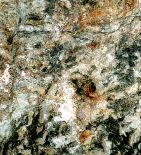
Two eye sockets and nose are seen in the center of the photo
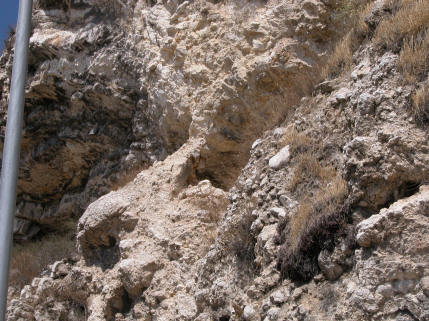
View from left side of skull shows a definite nose profile and eye sockets
150 yards east of the Garden Tomb is Skull Hill, or Golgotha - Place of the Skull, or the Latin equivalent - Calvary. "And He, bearing His cross, went out to a place called the Place of a Skull, which is called in Hebrew, Golgotha, where they crucified Him." John 19:17,18. It was below this area that victims were stoned to death, including perhaps Stephen, and approximately 70 yards to our left is the area where the crucifixion took place. Today there is an Arab bus station in front of Golgotha.
Ron Wyatt Begins His Work
Ron Wyatt completed extensive excavations in the Garden Tomb area over a period of approximately 12 years, beginning in January 1979. Ron began digging near the location where he mysteriously spoke the words, "There is Jeremiah's Grotto, and the Ark of the Covenant is in there" while walking through the area with the head of the Israel Antiquities Authority for the Jerusalem area. God placed those words in his mouth. The gentleman with him then said they would furnish his room and board to work on the project. This area was along a rock escarpment in the Garden Tomb grounds. While digging 12 feet down through the soil along the escarpment, Ron uncovered four crucifixion holes in solid rock, three on a lower level and one on a higher level and about 18 inches out from the escarpment measuring 12x13x23 inches deep. The single, higher cross hole was designed to be used on the special, featured victim.
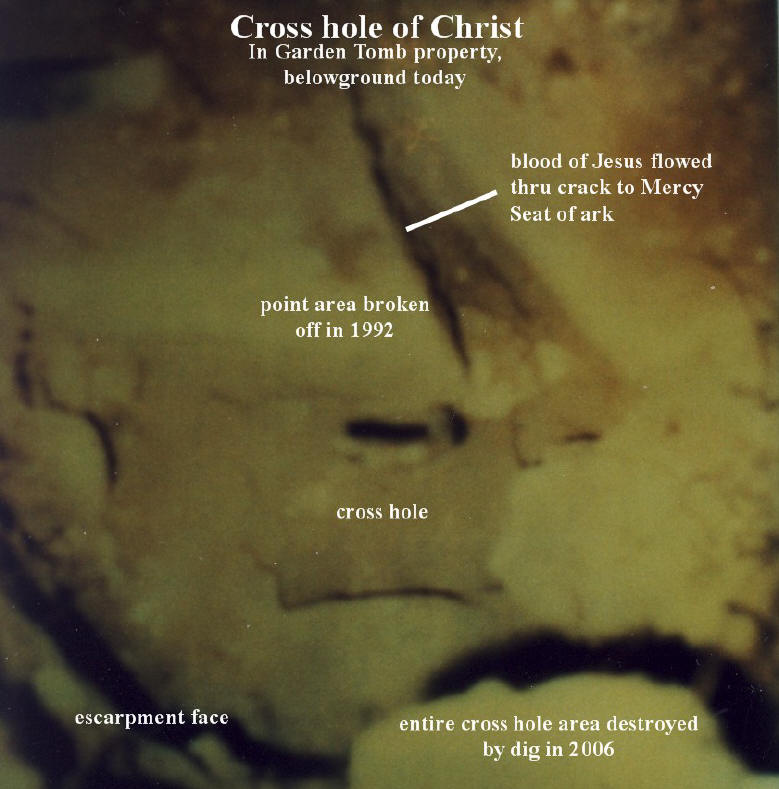
Above is a Polaroid photo Ron took of a square cross hole near the escarpment. The handle of a crow-bar is seen in the hole, as the bar is standing vertically. This bedrock is now covered by 12 feet of soil. photo courtesy anchorstone.com
Crucifixion site at Garden Tomb today....
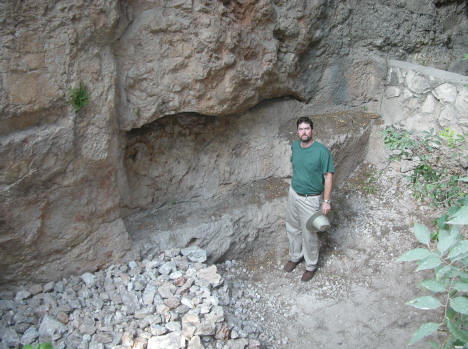
Kevin is standing next to the cut-outs where signs reading "Jesus of Nazareth, King of the Jews" were placed at the time of Jesus' crucifixion. Bedrock is 12 feet down. Jesus' crucifixion took place below this spot where he is standing, and the ark rests below that in a cave 20 feet below. Gold tests have shown a great deal of gold under this location, consistent with the ark, which should be 32 ft. below this spot, confirming the ark's location. Today there is a deck and white benches with a roof overhead.
This is on the left as you head back toward the Golgotha overlook.
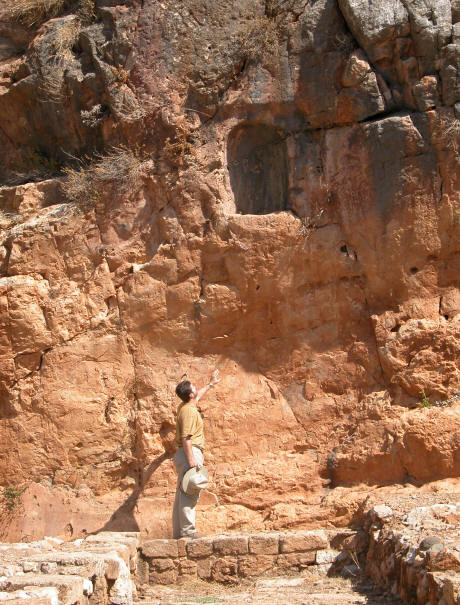
Above is another example of a cut-out in northern Israel at the Roman Temple of Pan at Cesaerea Phillippi that we found, similar to what we see at Jesus' crucifixion site.
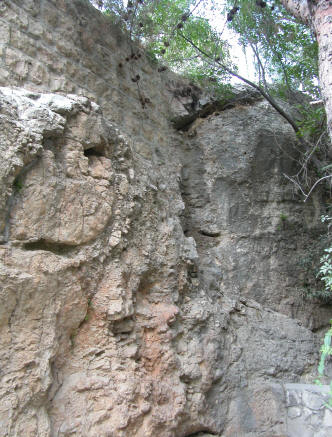
"The rocks were rent...." Matt. 27:51
Above the cut-outs near the Garden Tomb is a large crack in the escarpment extending up the face, behind the point where Christ was crucified. Lower portion of crack has been filled-in to prevent erosion.
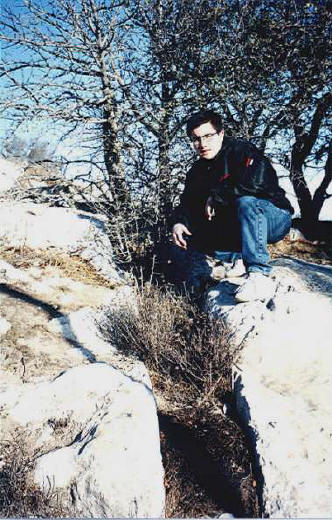
Above: At the top of the escarpment we can see how large the crack really is, but most of the crack has been filled in down near ground level. photo Aaron Sen
click here and then click subscribe
Finding the Ark
by Kevin Fisher
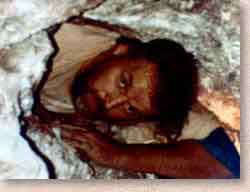
Ron Wyatt crawling through the tunnel system which leads to the cave where the Ark of the Covenant is located today. c. 1981
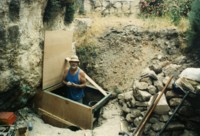
Ron Wyatt in the Garden Tomb grounds standing in the entrance to the tunnel leading to the Ark of the Covenant.
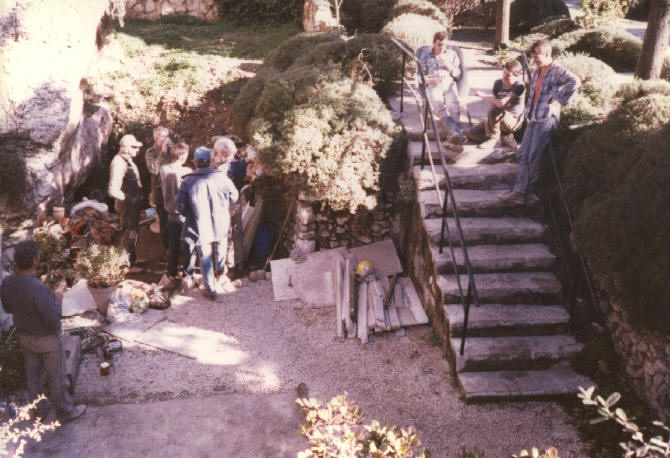
Above: A group assembled for work at the Ark of the Covenant excavation. Tunnel entrance to the left. Perhaps over a hundred people over the years helped Ron at the site.
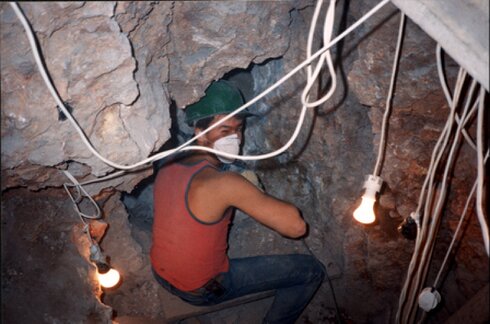
Inside tunnel system.
On January 6, 1982, after 11 trips to the dig site which entailed a couple of weeks of hard labor with each trip, and excavation permits issued by the Israeli Department of Antiquities, Ron Wyatt crawled into the cave where the Ark was located. In this cave were thousands of rocks that had been placed in there to cover the contents. There were animal skins on the furniture, then boards, then all these rocks. Ron found the Table of Shewbread, the 7-branch lamp stand, the Golden Altar of Incense, and the Golden Censer which all still remain there today. He saw a very large sword (perhaps Goliath's), numerous oil lamps, a brass shekel weight, a brass ring, and an ephod.
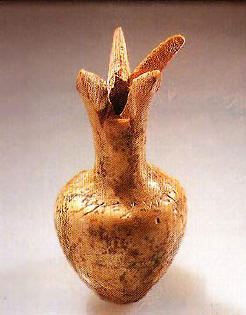
Any item Ron would find in the excavation he would turn over to the Israel Antiquities Authority, which he did. In 2005, I saw this ivory pomegranate in the Israel Museum in Jerusalem. Ron found it in 1979 and turned it over to the IAA after bringing it out of the tunnel system that led to the cave that houses the Ark of the Covenant. It is said to be the only item ever found and made public from Solomon's temple, in the first temple period. It is a thumb-sized pomegranate, about 1.75 inches, believed to be used by the Temple priests during one of their ceremonies. Around the shoulder of the pomegranate is a carefully incised inscription in early Hebrew characters, part of which is broken off, and reads: "qodes kohanim I-beyt [yahwe]h" or "Sacred donation for the priests of (in) the House of [Yahwe]h." "House of Yahweh" most probably refers to the Temple in Jerusalem. It has a hollow cavity in the base for mounting on a rod or shaft. The shaft is now resting in the cave with the ark, placed there by Ron. The pomegranate was a favorite motif in the Temple of Solomon. After Ron gave this to the IAA in 1979, the department was subsequently plundered and many items stolen, including this wonderful find. In 1981, it appeared in a French magazine. Then in 1988, an antiquities dealer in France sold it to the IAA for $550,000.00, according to the Biblical Archaeology Review. This ivory pomegranate has been featured in many articles, first in 1984, in the Biblical Archaeology Review while in the hands of the French, but no one has ever said where it was found. That is a mystery to most, but we know it was found in the tunnel system during the Ark of the Covenant dig. There is not a public dig associated with this find, so some folks doubt its authenticity. Ron Wyatt carried two parts of the pomegranate into the cave where the Ark of the Covenant rests today. The shaft or rod of the pomegranate was put in the cave as evidence of where it came from, and also one of the leaves, to show folks later that the temple furnishings are associated with the ivory pomegranate. Could Ron have left a note with these items? Probably....
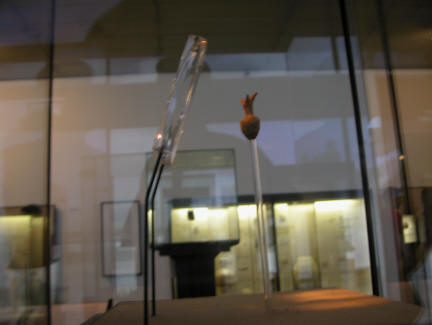
Above: Israel Museum October 2005, displaying the ivory pomegranate
(No photos allowed in the museum.)
When Ron first entered the cave, he noticed a dark substance that had dripped out of a crack in the ceiling directly above the Ark, onto the top of a stone sarcophagus, and down inside of it. The Ark was in a large stone sarcophagus and the top or lid of the stone case had been broken and moved aside, allowing the dark substance inside. The dark substance that was on the ceiling had dripped onto the top of the stone case and down inside onto the golden lid or Mercy Seat of the Ark of the Covenant.
It was at this moment that Ron realized the cross hole above communicated down to this cave below via a fissure in the bedrock, which allowed a dark substance or Jesus' blood to fall onto the Ark!! Ron passed out, as he realized that dark substance was the actual blood of Jesus! Ron was unconscious for 45 minutes, exhausted from double pneumonia, hard work, and amazing revelation.
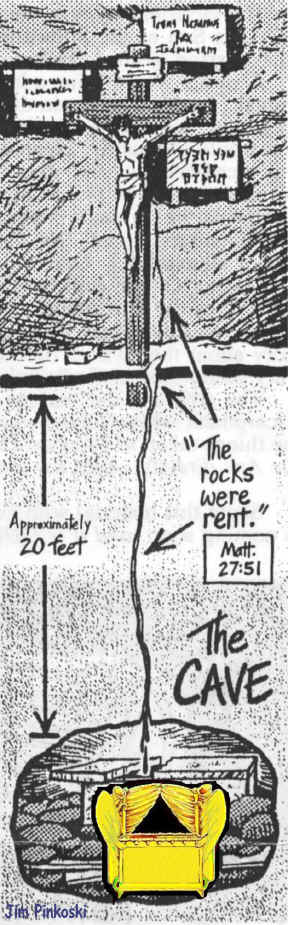
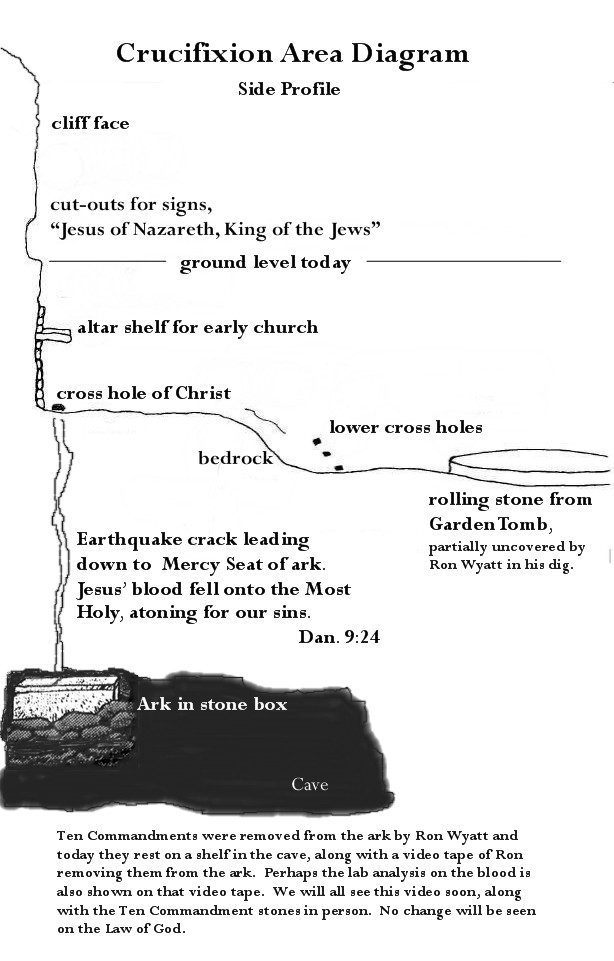
The cut-outs in the escarpment behind the cross were apparently designed to hold signs relating to the person being executed. In this case they would have said, "Jesus of Nazareth, King of the Jews," in Greek, Hebrew and Latin, and would have been on the cross also, but smaller in size. Surrounding the crucifixion site is the foundation of a first century church, and within this is the 13 ft. diameter rolling stone used to seal the Garden Tomb. Early Christians reverenced this site. The cross hole that was used to crucify Christ has a large crack in the bedrock next to it and the fissure extends all the way down to a cave below.
The Ark of the Covenant had been secreted into this cave in 586 BC when the Babylonians held Jerusalem under siege (II Kings 25). Jeremiah and his assistants wished to hide the furnishings of the tabernacle from the pagan invaders. But in reality this was part of God's plan. If the Jews had accepted Christ as the Messiah, the faithful Jews would have had possession of the Ark at the time of Christ and Jesus would have announced he was the Passover Lamb that day, and His blood would be the final sacrifice and would have been placed on the altar of incense and on the vacant western side of the Mercy Seat of the Ark. But God knew they would not accept His Son, so He had His own plan arranged to place the blood of His Son on the Most Holy, the Ark of the Covenant. The Roman soldiers were influenced by God to make the cross hole directly over the cave that hosed the ark of the covenant. When Christ died, "the rocks were rent," creating the crack in the bedrock leading down into the cave below. A Roman soldier speared Christ's left side, causing blood and water to flow through the crack into the cave below. The lid of the stone case containing the Ark of the Covenant, was broken and moved aside allowing Christ's blood to flow directly onto the Mercy Seat of the Ark. At this moment type met antitype. Both the old and new covenants were ratified by the blood of Jesus. The ceremonial system which looked forward to Christ's sacrifice, came to an end. At that moment the large, thick veil in the temple was torn by God from top to bottom and the sacrificial Passover lamb escaped, because Jesus was the final sacrifice. He was the REAL Passover Lamb. For 4,000 years God had waited for His Son to be the sacrifice. In the Jewish Passover, a family would select a Passover lamb on the 10th day of the month of Nisan and hold it four days, until the 14th, then it was sacrificed. God did the same with His Son. A thousand years is as a day to God. So, 4,000 years went by and in 31 AD, Jesus' time had come and He gave up His life for us. So amazing. As such it appears 2031 will be the 6,000 year mark for sin in this world. Could Jesus return that year? I think so....
Daniel 9:24 mentions this anointing of the Ark
"Seventy weeks are determined upon thy people (Jews), and upon thy holy city, to...make reconciliation for iniquity, and to bring in everlasting righteousness, and to seal up the vision and prophecy, and to anoint the Most Holy." "Most Holy" is Strong's word 6944 qodesh "a sacred place or thing" and is here twice, "qodesh qodesh" But before it we have the word "the" which is the definite article referencing an object, not a person. These words are used in the Bible in association with the Most Holy Place. Jesus was both the High Priest and sacrifice at his death. His blood anointed the Ark of the Covenant, or Mercy Seat, always found in the Most Holy Place.
The Jews were given 490 days (70 weeks x 7) and using the day for a year principle (Numbers 14:34, Ezek. 4:6) we know this was actually 490 prophetic years. Starting with Artexerxes decree to rebuild Jerusalem in 457 BC (verse 25), we find that this 490 years ended 3 1/2 years after Jesus' death at the stoning of Stephen marking the end of the Jewish dispensation. The Bible prophesied that Jesus (Messiah the Prince v.25) ministry would begin at 69 weeks at His baptism, then in the middle of the 70th week, after 3.5 years, He would "cause the sacrifice and the oblation to cease" v. 27 or offer his own sacrifice at the crucifixion. The forces of darkness have placed this 70th week in the future where the antichrist would show up, but all that theory does is to ignore the beautiful sacrifice that Jesus did for us on Calvary.
In Mr. Wyatt's fourth trip into the cave in approximately 1989, he dropped down into the cave and immediately felt that he was not alone. As he turned around he could see four men in the cave. One spoke and identified themselves as the four angels that had been guarding the ark since Moses put the ten commandments inside. He was stunned to see all the rock, boards, and other unnecessary items removed from the cave by these heavenly messengers. The furnishings were placed in their proper configuration in the cave. The cave wall behind the Ark is pure crystal and reflects all the colors of the rainbow. (The heavenly Ark has a rainbow over it.) In the past, Ron had wondered how he would ever clean out the cave. He was able to open the stone box in the past, peeling it apart piece by piece. Now the angels in the cave asked Ron to position his video camera to film what was to happen next. The four angels lifted up the top of the Ark and said, "Reach in, take the Ten Commandments out. When a world-wide law is enforced forcing men to violate the Law of God, then they will be shown to mankind." Mr. Wyatt held the 10 C's and one of the angels took them and placed them on a shelf in the cave. Later Ron returned to the cave with the video tape and the angel placed the tape on top of the ten commandments. The Ten Commandments are on two tablets of stone and have writing on both sides. They are written in Proto-Aramaic Mr. Wyatt said in 1999. But he also mention Proto-Canaanite, so it appears one side is written in one language and the back side another. Ronny Wyatt said one side was written in Hebrew (Proto-Canaanite) and the other side Arabic (Proto-Aramaic). One of the angels told Ron to take a sample of Christ's blood and have it analyzed. From what Ron said, the angel told Ron instructions that should be taken by the lab experts to reconstitute the blood, place it in a growth medium, and analyze the chromosomes. Ron did as he was told.
Mr. Wyatt removed a sample of Christ's blood from the Mercy Seat of the Ark in the cave and paid a lab in Israel to do an analysis of the blood. They put the dark dried-out substance in saline solution for 72 hours, then added a growth medium to the blood for 48 hours. Mr. Wyatt asked them to do a chromosome test, but they informed him that he was wasting his money since you can't do a chromosome test on dead white blood cells. They proceeded with the analysis and said, "It's your money." As they began viewing the cells under the microscope, they saw cells dividing before their eyes! They could tell it was human blood, but "This blood is alive!" They couldn't believe what they were seeing! They continued with their tests and found the blood to be unique from any other human blood! Each cell contained only 24 chromosomes compared to the normal count of 46 that you and I have. Christ received 23 chromosomes from Mary, and one "y" chromosome inserted to designate a male child. Others in the lab were asked to come see for themselves. With tears in their eyes they asked, "Whose blood is this?" Mr. Wyatt replied, "It is the blood of your Messiah." Then they asked who the Messiah was, and they began wailing and shouting. No other human being has ever had this same chromosome count! Christ's blood is alive and unique to prove His divinity to the world before He returns to this earth. When these tests are repeated for all the world to see, everyone will learn that Jesus was more than a preacher, He truly was, and is, the Son of God!
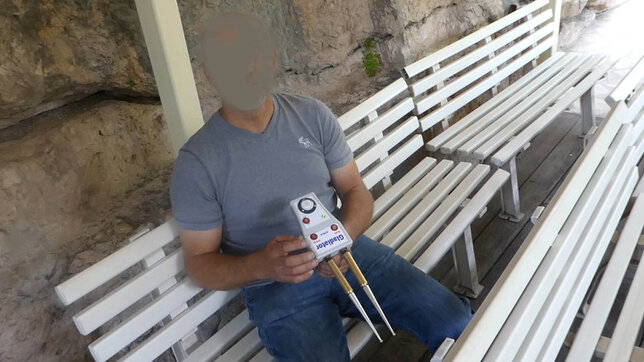
More on the cross hole of Christ
Q and A with Ron Wyatt
Ron: When the test results will be shown, nobody will be able to honestly doubt, that this is indeed the blood of God's Son. That is why He says that this is His Testimony of His Son. It is His proof to this world.
Q. What about the cells?
Ron: White blood cells. And you are saying how can you test a dead white blood cell for chromosome count? His blood is not dead. When put in a growth medium the cells divided and reconstituted themselves. If that doesn't blow your socks off, I don't know what will.
Q. What about the cells?
Ron: White blood cells. And you are saying how can you test a dead white blood cell for chromosome count? His blood is not dead. When put in a growth medium the cells divided and reconstituted themselves. If that doesn't blow your socks off, I don't know what will.
Q. Are you in possession of this blood?
Ron: Yes.
Ron: Yes.
Q. Do you have this second video available now?
Ron: I will share it with people who I can trust, when I am told to by one of the four angels that are guarding the Ark of the Covenant, when to release it and to whom. Because I can't tell, people can fool me, I'm not that clever.
Ron: I will share it with people who I can trust, when I am told to by one of the four angels that are guarding the Ark of the Covenant, when to release it and to whom. Because I can't tell, people can fool me, I'm not that clever.
Are there any other questions? Yes Ma’am?
Q. Are you saying that you were able to take a video camera in there and video? Is, is that what I judge you are saying?
Ron: Well, I didn't say that. But there is video available of ALL of this. And this will be shown when I'm told to do so: (1) the Ark of the Covenant, (2) my removing the Tables of Stone out of it, (3) and the blood, and (4) me taking the sample, (5) the analysis. I didn't do this. I took it to a place in Israel where they do this kind of thing. They thought I was crazy when I asked them to do a chromosome count. But after they saw the results, they went crazy.
Ron: Well, I didn't say that. But there is video available of ALL of this. And this will be shown when I'm told to do so: (1) the Ark of the Covenant, (2) my removing the Tables of Stone out of it, (3) and the blood, and (4) me taking the sample, (5) the analysis. I didn't do this. I took it to a place in Israel where they do this kind of thing. They thought I was crazy when I asked them to do a chromosome count. But after they saw the results, they went crazy.
This Witness of Christ Will be Shown Soon
The Bible speaks of the water and blood that came from the side of Christ at His death, and how it will be a witness to mankind that Jesus is the Son of God. "For there are three who bear witness in heaven; the Father, the Word, and the Holy Spirit; and these three are one. And there are three that bear witness on earth; the Spirit, the water, and the blood; and these three agree as one. If we receive the witness of men, the witness of God is greater, for this is the witness of God which He has testified of His Son." I John 5:7-9. In due time, the blood will testify that Jesus is the Son of God. "For there is one God and one Mediator between God and men, the Man Christ Jesus, who gave Himself a ransom for all, to be testified in due time." I Timothy 2:5,6.
"...gave Himself a ransom for all, to be testified
in due time."
in due time."
This testimony is about to take place when the mark of the beast law is enforced. The world will learn of Jesus' Divinity and they will see the Ten Commandments which reflect His character. Everyone will be tested in their form of worship. Follow God and His Son and obey the Ten Commandments, or receive the mark of the beast.
Mr. Wyatt has theorized that the cave housing the Ark will be an eternal resting place for it, and may be part of the temple of the New Jerusalem where the 144,000 will visit when the earth is made new.
When a law is passed, a Sunday law, forcing men to violate the fourth commandment law of God, the Ten Commandment tablets of stone will come out of the cave. This is what the angel told Ron. Ron was a Sabbath keeper, the day Jesus kept. Jesus was alive 40 days after His resurrection and He never announced a new day of worship. But the papacy came up with Sunday as the new day for Christians to worship. God did not.
Also, independent genetic scientists will perform their own analysis of the blood of Christ and will reveal the test results to the world. Everyone will have an opportunity to see the Ark on video, and some people will be able to see the Ten Commandment tablets in person. Everyone on earth will have an opportunity to accept Jesus as their Savior and ask forgiveness of their sins, and follow the law of God, all then of them, not just nine. Shortly after this the Lord will return. God is providing a simple yet effective show-and-tell demonstration to the world. Some will be moved to follow God, but the majority will continue following self and will not repent. The vast majority of the world have grown up in false forms of worship and need an opportunity to come into the truth and follow their Creator. God will use the Ark and Christ's blood to finish spreading the Gospel to the world, and then He will return.
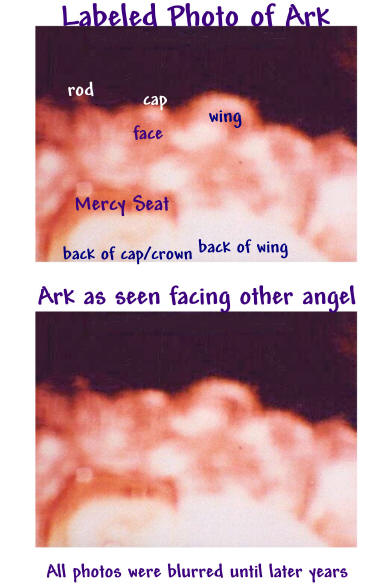
Many people have asked for photographic proof of Ron's finding the ark. Ron says we should wait until the Lord wants it revealed. He had taken hundreds of photos using 35mm, Polaroid, and video but they are were blurred because God did not want Ron to be showing this evidence at that time. Ron knew then that he was to wait until the Lord's time. Subsequently he was able to get clear photos of the ark, but he did not make them public, but instead gave them to someone to hold. I have spoken to this person. Ron held these photos back in order to follow God's direction, meanwhile, he was criticized.
In approximately 1995, there were six Jews who were descendants from the tribe of Levi, the caretakers of the ark in Moses day, who took it upon themselves, under the oversight of the department of Antiquities, to venture into the tunnel leading from Zedekiah's cave and up to the ark. Their intent was to remove the ark and begin animal sacrifices. Since the ark is not in Israeli controlled territory, but in occupied territory, they felt it necessary to move the Ark to their land. They had made it about 75 feet into the 375' tunnel when they all began screaming, then they died. They were in contact with others outside the tunnel via two-way radio. Days later, Ron Wyatt was in Jerusalem and the IAA asked him to remove their bodies from the tunnel, which he did. They would not go up that tunnel.
The Ark of the Covenant And Ron Wyatt's Discoveries
October 5, 1998
by Bill Fry www.anchorstone.com
October 5, 1998
by Bill Fry www.anchorstone.com
In 1978, Ron Wyatt was walking along the Calvary Escarpment when something happened to him that only occurred once in his life. While walking with a member of the Israeli Department of Antiquities his left arm raised up and pointed to the escarpment and these words came out of his mouth, "That's Jeremiah's Grotto and the Ark of the Covenant is buried in there." Ron had no control of what he said, it was the Lord giving him those words to speak. This man then said, "That's wonderful! We will not only furnish you a permit, we'll put you up in a place to stay, have your laundry done and furnish your meals!"
Ron and his sons came back several times over the next few years and spent hundreds of hours digging at that location. Ron finally found and entered the cave that contained the Ark of the Covenant on January 6, 1982.
On that trip his two sons became sick and had to return home early. Ron continued working in the cave system with a small Arab man as his assistant. He found a narrow vertical crevice in a rock wall too narrow for him to fit through but with a little work it was "just right" for his helper. The man squeezed into the opening. But before Ron could hand him a flashlight to look around with, the man came scurrying out of that chamber as fast as he could saying, "What's in there? What's in there??" He was scared to death! From that point forward the man refused to enter the cave system. He now lives outside Israel and because of governmental visitor regulations he cannot reenter the country.
During Ron's excavation in this area, he found the location of Christ's crucifixion. Christ was crucified up against what is known as the Calvary Escarpment, very near Golgotha and the Garden Tomb. When Christ died on the cross, "the rocks were rent." That earthquake split the escarpment! There is a vertical crack directly behind where the cross was placed. When Ron excavated down approximately 14 feet below present ground level at that location, he found the cross hole. It was 13 inches by 14 inches in width, and 23 ½ inches deep, and there was a stone "plug" in the top of it that was square-like and approximately 8 inches thick. But most importantly, there was a very sizable split in the rocks on the left side of the cross hole!
When Christ died on the cross and the centurion stabbed him in the side with his spear, Christ's blood and water flowed out. Christ's blood went into the large crack in the ground at the base of the cross, and it continued underground through the split in the rocks caused by the earthquake, and the blood of Jesus Christ, the Son of God went upon the Mercy Seat of the Ark of the Covenant that was buried in the cave that is approximately 20 feet right below the crucifixion site! (The prophecy in Daniel 9:24 foretold of this very wonderful and special event! The "most holy" place was anointed with Christ's blood!)
When Ron entered that cave at 2:00 p.m. on the afternoon of January 6, 1982, this is what he saw: There was very little room to crawl around because the things placed in the cave left only about a foot and a half of crawl space between them and the ceiling of the cave. There were rocks on top of boards, on top of animal skins. When he shined his flashlight down between the rocks, he saw that much of the wood and fur were rotted away and he saw "gold" glittering down underneath the rocks. Then at the far side of the cave he saw a stone box.
The lid of the box was cracked and the smaller portion of the lid was moved aside a short distance. At this point Ron realized what had taken place there nearly 2000 years ago! Overwhelmed with the emotion of this revelation, Ron passed out for 45 minutes in that chamber.
The Blood
Hopefully soon it will be time to reveal the Ark of the Covenant to the entire world. When the Lord says, "It is time," some humble man will return and re-enter that cave and take along with him a camera crew and one or more genetic scientists. We will see them take a sample of Christ's blood (there is a dried pool of it on the Mercy Seat!), and we will see the test results of that extremely unique blood! Ron has already tested his own sample and he knows what the results will be. Remember, Ron works as an anesthetist in several hospitals and he has seen lots of blood.
Christ's blood has only 24 chromosomes!!! Normal human blood has a total of 46 chromosomes. When a child is conceived, 23 chromosomes come from the mother (all of these are "X" chromosomes), and 23 come from the father. If a child is to be a male child a "Y" chromosome is provided by the father and that chromosome designates the child will be a male. Christ's blood has only 24 chromosomes! There are 23 from his earthly human mother and only one "Y" chromosome from His heavenly Father! No other human blood like this has ever existed on the earth! The scientific term for this is "ploidy" or "haploidy." There have been known examples of females born with only half the normal chromosome count - 23 - but never a male child, because the father has to provide that distinctive "Y" chromosome! Praise the Lord! God will scientifically prove beyond all reasonable doubt that Jesus was no mere "good teacher" or "just a good man." Jesus Christ was the divine Son of God!
The key to understanding what the Ark is and its significance to us today lies in studying the sacrificial system which was established by God when man fell and was cast out of the Garden of Eden.
All of the objects in the earthly tabernacle, in the Sanctuary, were "patterns of things in the heavens." Hebrews 9:23. The Ark represented God's throne where His presence was evident among the people. This throne was a copy of the great throne in heaven. The Ark resided in the second apartment of the Sanctuary - "The Most Holy Place."
The sacrificial system was designed to show the awful results of sin and how God Himself would ultimately offer His Son as the Sin bearer to atone for the sins of mankind. "Without the shedding of blood, there is no remission of sin." Hebrews 9:22.
A sinner would bring a lamb or a dove to the Sanctuary, confess his sins, then take the life of that innocent animal. In this act the sin did not vanish, the sin was transferred to the Sanctuary. This happened all year long and then once a year, on the Day of Atonement, the High Priest would make a very special sacrifice that would ultimately "cleanse the sanctuary." Lot were cast over two goats. According to the outcome one was sacrificed and the other was ushered out into the wilderness after ALL THE SINS which had accumulated in the Sanctuary were placed upon this "scapegoat," where it would die in the wilderness. (Leviticus 16) This goat represents the ultimate punishment of Satan.
Christ represented "the perfect lamb of God" and He died on the cross and shed His blood to atone for the sins of all mankind. Currently Jesus is our "High Priest" and He is officiating on man's behalf in the heavenly Sanctuary. On the earthly Day of Atonement the goat's blood was sprinkled on the top of the Mercy Seat of the Ark of the Covenant. At His death on the cross, CHRIST'S BLOOD fell upon the Mercy Seat of the Ark of the Covenant! This scenario NEVER occurred to Ron before he entered that cave in 1982 and saw what had happened with Christ's blood. No other story about the Ark of the Covenant makes more sense than this one. This scenario is the ONLY one that truly accomplishes God's holy purpose in regard to the Sanctuary service!
The Ark and the various other items from the first temple were hidden in this cave below the Calvary Escarpment when Nebuchadnezzar sacked Jerusalem and destroyed the temple in 586 B.C. There is a list of the things taken to Babylon (2 Kings 25), but the Ark was not included! Temple priests were led by God to hide the Ark directly under the place where His Son would die approximately 600 years later!
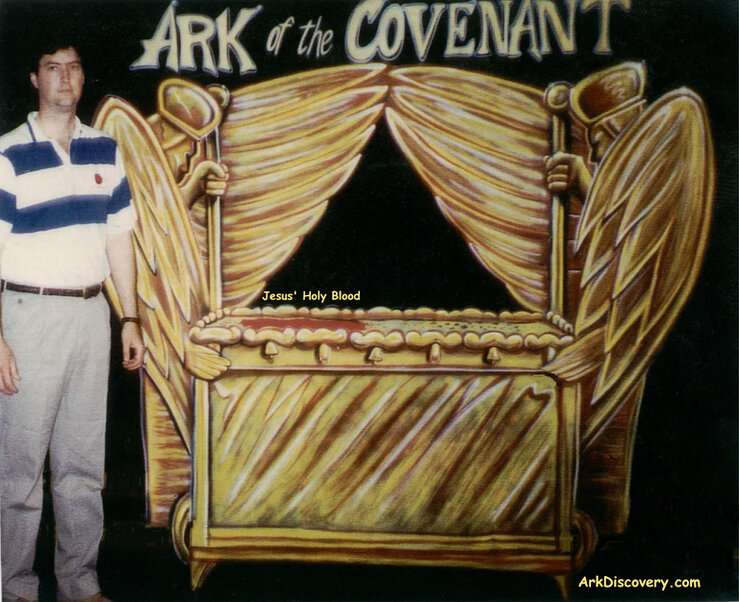
Above: Kevin with the Ark of the Covenant banner in his apartment before he presented it to Ron Wyatt for his museum, 1997. Museum is closed now.
Importance of the Tables of Stone
Although the discovery of the Ark of the Covenant is a fantastic, God- inspired discovery, of greater importance is what was contained inside of it--the two tables of stone, which are the 10 commandment moral laws written- out for the children of Israel by God Himself with His finger.
The miracle of how Ron was helped by four angelic beings to retrieve these is a story in itself which is too long to relate here, but shows the extreme importance of these two tables of stone, and the fact that they were brought to light at this very time, indicates God has plans to bring these to the light at the proper time.
These tables are a reflection of God's character of love, the first four entail our obeying them because of our love for Him. He once said, "If ye love me, keep my commandments." The last six contain our responsibility to our fellow man, and entail our love for him.
Unlike what people think, these tables or 10 commandments are not a method of salvation to gain heaven, but the standard of salvation. They are not a way to work yourself to heaven like the ancient Jews engaged in, but rather a standard of righteousness given as a guide to lead us to Christ. Paul says that the law was our "schoolmaster" or standard to teach us how to live.
Now God has a very special purpose is bringing these tables of stone out of hiding after 2600 years. The last great battle (Armageddon) will be fought over God's moral laws of right. Thousands of years ago the enemy introduced into the Christian church errors in the doctrines and beliefs of the church which usurp God's law. It is planned by the enemy to bring about events that will force, if possible, everyone in this world to choose the enemy's law over God's. This will be the last great test for humanity. But people need to know what God's law says in clear unmistakable terms, before they can decide whose side they will choose to be on. This is where the tables of stone come in. At the time of the test, they will be brought forth by a person of God's choosing to be seen by the world.
At that time there will also be brought forth the concrete, scientific evidence about the Ark through a video tape, and God's eternal law and the evidence of Jesus' blood spilled upon the mercy seat of the Ark. This is God's show- and- tell to the world as a witness and irrefutable evidence of His Son's sacrifice for lost mankind.
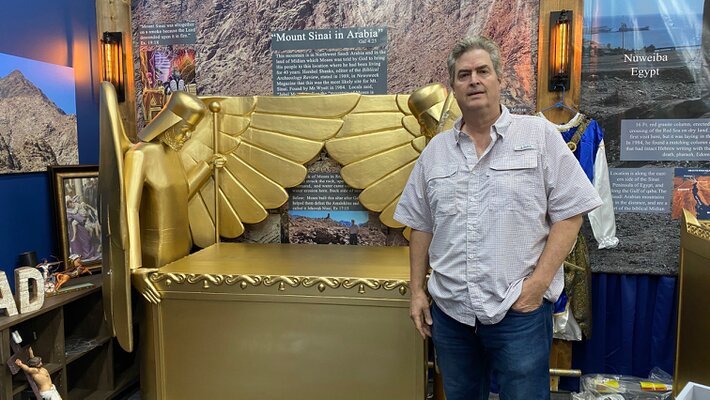
Above: Kevin with the lifesize ark of the covenant replica model in his studio.
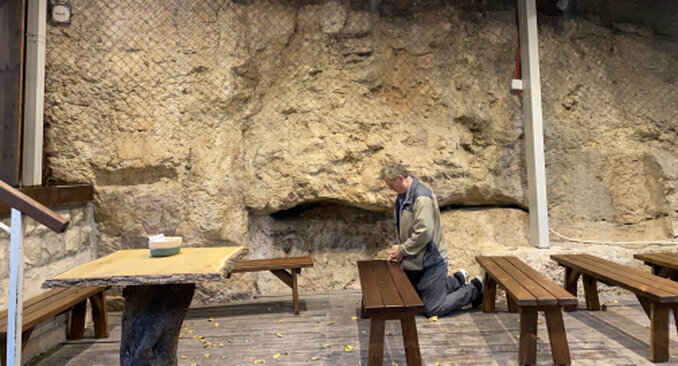
Kevin praying at the cutouts in the rock where Jesus died for us, 12 ft. below that spot, and the ark of the covenant below that.
[The incredible account of what actually happened in that chamber on Ron's 4th visit was recently posted on "Anchorstones" website by Bill Fry, close friend of Ron's who worked closely with Ron and was entrusted with giving out the following information when it was time. This is the greatest physical manifestation and revelation of God's intentions to this present world. It means that God has set the stage and that the curtain is about to rise on the stage of the last act of this earth's history. It means that the last scenes described in the book of Revelation are about to commence, and that Jesus is soon to come and take home with Him all those who are faithful to Him.]
Ark of the Covenant Update
May 16, 2000
by Bill Fry
May 16, 2000
by Bill Fry
Approximately 6 weeks after I began to write this update in June 1999, Ron Wyatt died in a Memphis hospital from colon cancer. I had promised Ron that I would not post this update until he had a chance to review it for accuracy. To insure that accuracy, Ron allowed me to record our phone conversation as he told me the story and as I asked specific questions.
I must say now that I will not be making this tape available publicly. So please, don't ask. The reason is that this conversation was taped during the last weeks of Ron Wyatt's life and it is very apparent that he was in quite a bit of pain during portions of our conversation. Because of that I don't like listening to the tape, even to this day. Therefore, out of respect for Ron, I will not be making the tape available to anyone. There are no details on the tape that are not covered in the update.
Unfortunately, before I was able to finish writing the update Ron became very sick and was never able to review what I had written. However, the audio tape testifies to the accuracy of this update; that I wrote only those things that Ron passed on to me. I have added a few minor details to the story from information that Ron has passed on publicly at various times and places but the main points of the story comes directly from our taped conversation.
Since his death, I have not known exactly how to proceed in sharing this information. I counseled with a number of people about this and finally decided that I would not share it until I was impressed that the time was right. It is for that reason that I now share with you the experience that Ron Wyatt had in the Ark of the Covenant chamber.
Over the last couple of years there have been stories circulating about an encounter that Ron Wyatt was supposed to have had with an angel. According to the stories he was given instructions about the Ark of the Covenant, when it would be revealed, and exactly how he was to proceed with his work on the discovery. I have personally had several different versions of these stories sent to me with requests that we confirm or deny them. These people go onto to insist that if they are true that we post them so that all can have access to this information. To date none of the stories that have been sent to me are complete or accurate.
After I explained the situation to Ron in June of 1999, he made the decision to have me write out the actual event as he had twice related it to me and then post it on our web site so that the inaccuracies of the other versions could be corrected. He felt that it was better to tell the story himself rather than allow different versions to circulate with none of them being completely accurate.
As you read this account of Ron's encounter inside the chamber where the Ark of the Covenant is located, please remember that what is being related is an event that has a number of supernatural aspects to it. We understand that this may create an opportunity for some people to mock and ridicule, but we feel that this is better than allowing bad information to continue to circulate and confuse people.
When Ron originally began his excavation at the Calvary escarpment in 1979, he began at the place his hand had pointed to during his encounter with the Israeli Antiquities representative. It is important to understand that Ron was searching only for the Ark of the Covenant. Searching for and finding the crucifixion site was not in his thoughts until it became apparent from the evidence at hand that this was what they had found.
From that point they did months of digging and tunneling along the escarpment wall looking for an opening into some type of cave or tunnel. After praying about the matter Ron was impressed to break through the escarpment wall at a spot near the crucifixion site and thus enter the tunnel system that honeycombs that portion of Mt. Moriah. When he did this he found himself in a series of tunnels that it took many months to explore. During that process he finally found his way into the chamber where the Ark of the Covenant was hidden.
When Ron first entered the chamber it contained a number of items including some of the furnishings from the first temple which were covered with animal skins, wood and then stones stacked on top of them to about 18 inches from the ceiling. For this reason the only way he could move around within the chamber was to crawl on either his back or his stomach. At the far end of the chamber was a stone case with a broken lid whose top was only a few inches from the ceiling. This prevented him from seeing the Ark on his first visit to the chamber but it helped him notice the crack in the ceiling and the brown substance (the blood) which was directly above the stone case. He assumed and later confirmed that this stone case contained the Ark.
On his later visits to the chamber he tried with several different types of still and video cameras to get a clear picture of the Ark. But each time the pictures came out either "washed out" or blurred beyond use. This was a source of great frustration and embarrassment for Ron; to not be able to produce one clear picture of this wonderful discovery. On his fourth visit into the chamber he took with him an 8mm video camera and tripod, determined to finally get a clear shot of the Ark.
As he entered through the same opening he had always used to access the chamber, he immediately recognized that something was very different. The rocks that were always there inhibiting his path were no longer in place. In fact he was able to enter the chamber and drop all the way to the floor. At this point a light came on in the chamber, the source of which he cannot fully explain. Ron then saw that the chamber had been completely cleared of all the rocks and debris, a task Ron had known would need to be done but which would take a long time to accomplish. But now the job was already completed! The chamber was completely clean with no sign of the any of the debris and the Ark of the Covenant was out of the stone case.
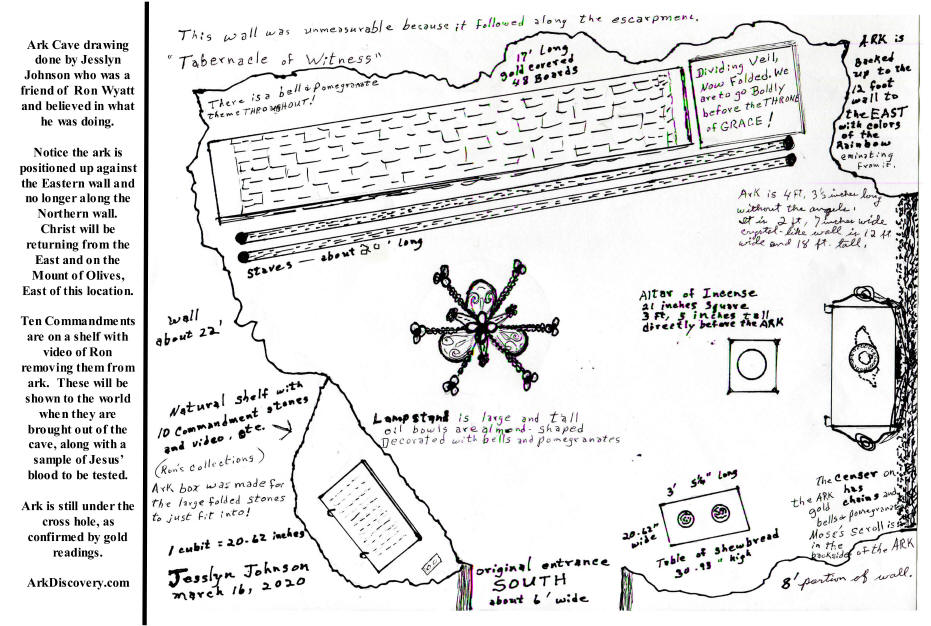
As you can imagine Ron was stunned by what he saw. The Ark had been placed against the eastern wall of the chamber directly underneath the crack in the ceiling where Christ's blood had flowed onto the Mercy Seat. The other temple furnishings were set in their proper place relative to the Ark. The rest of the items were set off to one side.
A number of very important artifacts are there in that cave. In the back of the Ark is the "book" that Moses wrote - the first five books of the Bible. They are written on a leather scroll that is as fresh and supple as the day it was written! Just as the shoe leather of the Israelites did not wear out in the desert, this leather has also remained in perfect condition and shows no deterioration. Several other artifacts from the first temple are in that cave, including the table of shewbread, the seven-branched candlestick and a 5' 2" sword that most likely was Goliath's sword!
Although he cannot explain how, the wall directly behind the Ark had the appearance of crystal and was glowing with the color pattern of a rainbow. It appeared to Ron that the rest of this crystalline wall was the source of the light which was illuminating the chamber. As he was taking in the sight he suddenly realized that he was not alone in the chamber. Ron stated that he could "feel in his body that he was in the presence of angels."
He saw that there were four young men in the chamber with him. They did not look like angels but appeared as young men dressed in normal "street clothing." But Ron knew that they were angels. He stood there frozen for a few moments unable to move or even speak. He wanted to ask them what they were doing in there but he was not able to do so.."
Then one of the angels stepped forward (this is the only one of the four that would speak to him) and told Ron that they were the ones whose job it was to guard the Ark of the Covenant. They had done this since Moses had first placed the tables of stone in it. He told him that God wanted people to see all of these things at a particular point in time. He then instructed Ron to set up his tripod and video camera in a certain place and turn it on.
Once Ron had done this the four angels went over to the Ark, lifted off the Mercy Seat and placed it beside the Ark. The angel that had spoken to him beckoned him forward and told him to take out the tables of stone. Ron leaned over and picked up the ten commandment stones. He then backed away a few steps and the angels placed the Mercy Seat back on the Ark. After a few awkward moments the angel reached out and took the tables of stone from Ron, walked over to a niche in the chamber wall that looked like a shelf and placed them on it. This "shelf" was close to the original entrance that was used by those that had hidden the Ark there over 2500 years ago.
He then walked back over to Ron and told him two things. The first was that if Ron remained faithful, he would have a part in bringing out the tables of stone so that they might be put on display. The second was that the Ark was not to be revealed to the world or the tables of stone put on display until shortly after a law was passed that would attempt to enforce the mark of the beast upon people.
Ron died on August 4, 1999, so the method that will involve his revealing the Ark of the Covenant to the world involves a video tape he left in the cave of himself, removing the Ten Commandments from the Ark. The entire world will see Ron Wyatt removing the Ten Commandments from inside the Ark.
"The second part of the angel's comment "that the Ark was not to be revealed to the world or the tables of stone put on display until shortly after a law was passed that would attempt to enforce the mark of the beast upon people." The angel said that the tables of stone would be put "on display SHORTLY AFTER a law was passed that would attempt to enforce the mark of the beast upon people."
Shortly there will follow a death decree against all true 10 Commandment keepers and the time described as the time of Jacob's trouble would commence. This ends in the deliverance of the saints who refuse to receive the mark of the beast. At that time the Special Resurrection will take place, where all those since 1844 who died keeping the third angel's message (Rev. 14) will be raised from their graves with their immortal bodies. This would of necessity be after the time of Jacob's trouble and at the time of the deliverance of the saints from the death penalty connected with the mark of the beast law.
When the time comes we will see the Ten Commandments removed from the Ark of the Covenant! Hopefully they will go on display and travel around the world like the King Tut Exhibit and you and I will get to actually see them in person! Ron says that they look as if someone wrote in soft butter with their finger and then turned them to stone!
After that encounter Ron gathered up his camera equipment and left the chamber through the original entrance. By following this tunnel he was able to find his way out of the cave system and back onto the street. He immediately rushed to his hotel room where he played back the tape of the event. He had to see if the Ark, the angels and the tables of stone showed up clearly on the video. To his amazement everything showed up clearly. He was very excited. But suddenly his excitement turned to dread. He realized what he had in his hands, yet the angel had told him that these things were not to be revealed until the mark of the beast law was passed. What was he to do with this tape? It was undoubtedly the most important video ever recorded. Where would he put it? How would he keep it safe!?
[Web host note: Ron also went to the lab to film the testing of the blood. It is possible that first lab test is also on the video tape. KF]
Having no clear answer to these concerns, he finally decided that the best way to proceed was to go back to the chamber and ask the angel what he should do. He went back into the chamber and the four angels were there. The angel that spoke to him earlier stepped forward and asked him what he wanted. Ron told him that he did not have a safe place to keep the tape. Then the angel reached out and took the tape from Ron's hand. He walked over to the place where the tables of stone were still sitting on the niche in the chamber wall and placed the video tape on top of them. To the best of Ron's knowledge that is where everything remains to this day.
While this was the extent of what the angel told him, Ron said that he came away from this experience knowing more than he had been told in words. He was strongly impressed that while the video he recorded in the chamber would be shared with the world and that the tables of stone on which God Himself had written His Law would be put on display, the Ark of the Covenant would remain in the chamber where it is.
It is on the basis of this information, plus his agreement with the Israeli authorities, that he acted as he did in withholding certain information about the Ark and its location.
Ron also stated that as far as he knows no one else has been in the chamber except himself. However, because he is not always there, it is possible that someone else has or could enter the chamber and see the Ark IF the angels guarding it would allow it. Otherwise, the way the tunnel system is in that area, no one would be able to find their way.
On this last point I need to share an experience. I visited the entrance into the tunnel system recently and found a number of men furiously digging in an area where they thought the entrance into the tunnel system was. I went over to them and explained that not only were they digging in the wrong place, they were digging in an area that had caved in a number of times and that Ron had back filled to keep people out. Amazingly they told me that they had just recently prayed that God would send someone to tell them if they were doing the right thing or not. Because I showed up shortly after their prayer they took my counsel and stopped digging.
The point of my story is this. There are a number of people that think they know where the entrance into the tunnel system is. They are mistaken. The entrance does not require any digging or tunneling to get into today. Because of the sensitive nature of this information I cannot reveal where that location is but I can tell you that it is both dangerous and illegal to dig where these gentlemen were digging. They are fortunate that there was no accident or that they were not seen by the local authorities.
My appeal to everyone is that we allow God to do things on His timetable and not feel that we have a mandate to inject ourselves into the event. This is exactly what those six Jewish men who died in that tunnel were doing. I would hate to see a repeat of that.
God will deal with His things in His own time and in His own way. No one will miss this event. The time will come when all will be able to see the Ark, the blood and the tables of stone.
"And beside this, giving all diligence, add to your faith virtue; and to virtue knowledge; And to knowledge temperance; and to temperance PATIENCE......" 2 Peter 1:5,6
In-depth account of Ron Wyatt's dig for the ark
The Four Angels And The Ark Of The Covenant
Transcript Of A Talk By Ron Wyatt April 6, 1996
Transcript Of A Ron Wyatt Talk 1-9-99
An Analysis From a Geneticist of Mr. Wyatt's Description of Christ's Blood
For more about the sacrificial system and its significance,
see our next page...
see our next page...
