Noah's Ark
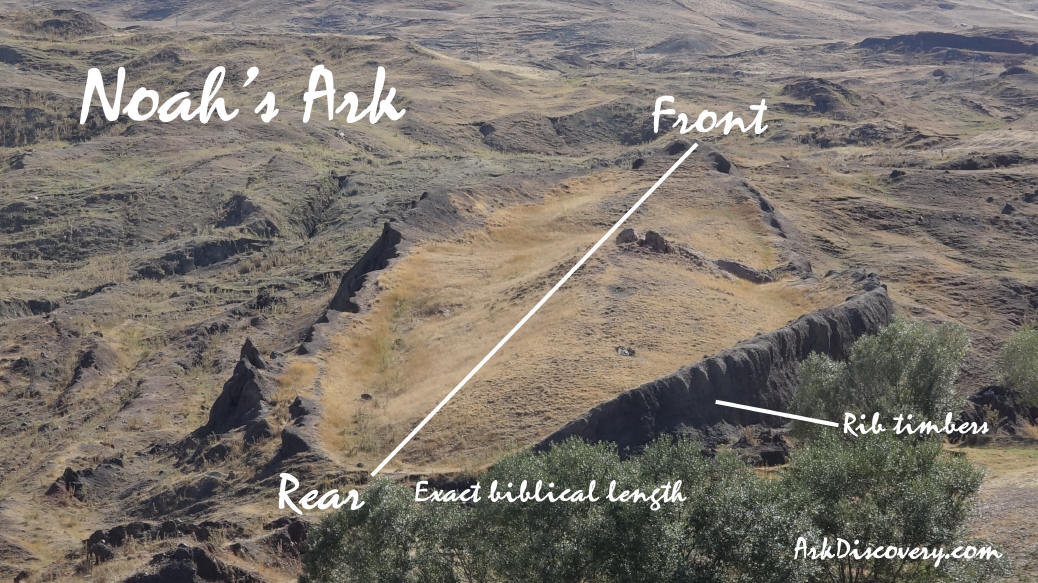
Above: Ark with features labeled
click here and then click subscribe
Please prayerfully consider the evidence you will see on Noah's Ark. It may not be important or necessary for you to learn of this discovery, but there are millions of people who need confirmation of biblical artifacts in order to strengthen their faith in God and the Bible. Satan is strongly attacking this and other discoveries in order to deceive men of God's truth. All the false stories about finding Noah's ark were created by Satan to "muddy the water," and cause disbelief in the genuine.
The Real Noah's Ark!
Top Points to Consider
Top Points to Consider
- It is in the shape of a boat, with a pointed bow and rounded stern.
- Exact length as noted in biblical description, 515 feet or 300 Egyptian cubits. (Egyptian not Hebrew cubit would have been known to Moses who studied in Egypt then wrote Genesis.)
- It rests on a mountain in Eastern Turkey, matching the biblical account, "The ark rested . . . upon the mountains of Ararat" Genesis 8:4. (Ararat being the name of the ancient country Urartu which covered this region.)
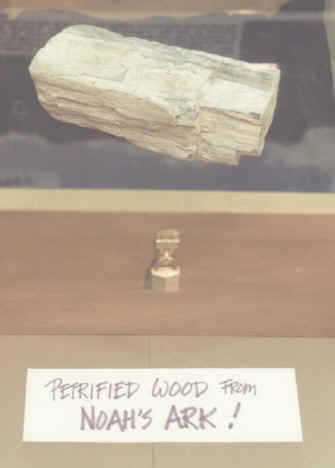
- Contains petrified wood, as proven by lab analysis.
- Contains high-tech metal alloy fittings, as proven by separate lab analyses paid for by Ron Wyatt, then performed later by Kevin Fisher of this web site. Aluminum metal and titanium metal was found in the fittings which are MAN-MADE metals!
- Vertical rib timbers on its sides, comprising the skeletal superstructure of a boat. Regular patterns of horizontal and vertical deck support beams are also seen on the deck of the ark.
- Occupied ancient village at the ark site at 6,500 ft. elevation matching Flavius Josephus' statement "Its remains are shown there by the inhabitants to this day."
- Dr. Bill Shea, archaeologist found an ancient pottery sherd within 20 yards of the ark which has a carving on it that depicts a bird, a fish, and a man with a hammer wearing a headdress that has the name "Noah" on it. In ancient times these items were created by the locals in the village to sell to visitors of the ark. The ark was a tourist attraction in ancient times and today.
- Recognized by Turkish Government as Noah's Ark National Park and a National Treasure. Official notice of its discovery appeared in the largest Turkish newspaper in 1987.
- Visitors' center built by the government to accommodate tourists further confirms the importance of the site.
- Huge anchor stones were found near the ark and in the village Arzap, 15 miles away, which hung off the rear of the ark to steady its ride.
- The ark rests upon Cesnakidag (or Cudi Dagi) Mountain, which is translated as "Doomsday" Mountain.
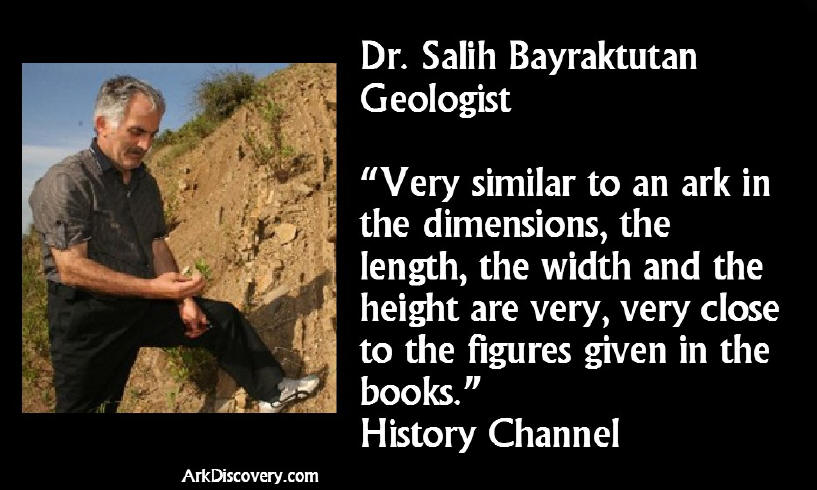
- Dr. Salih Bayraktutan of Ataturk University stated, "It is a man made structure, and for sure it's Noah's Ark" Common Sense. This same article also states "The site is immediately below the mountain of Al Judi, named in the Qur'an as the resting place of the Ark." Houd Sura 11:44
- Radar scans show a regular pattern of timbers inside the ark formation, revealing keels, keelsons, gunnels, bulkheads, animal chambers, ramp system, door in right front, two large barrels in the front 14' x 24', and an open center area for air flow to all three levels.
- New, 2016, high resolution, resistivity scans were done on the ark and reveal the same man-made elements that Ron Wyatt found in his 1985 scans. See www.noahsarkscans.nz
CAUTION
About Dig Announcements
About Dig Announcements
Multiple recent dig announcements have been made concerning Noah's ark,
but none have taken place. Dig fees and donations have been requested.
Verify a dig permit from the government before paying money to be on a dig or to donate.
This Turkish website lists digs going back to 2014, and as we have already searched, and none exist.
but none have taken place. Dig fees and donations have been requested.
Verify a dig permit from the government before paying money to be on a dig or to donate.
This Turkish website lists digs going back to 2014, and as we have already searched, and none exist.
http://www.kulturvarliklari.gov.tr/TR,44150/kazi-ve-yuzey-arastirmalari-faaliyetleri.html
Yer = location and Il = city. Province is Agri and city is Dogubayazit
Don't take the word of someone excitedly saying "we are going to have a dig this Summer."
A government permit has to be issued first, and we know that the government
is reluctant to issue a permit for this site per the government archaeologist we work with.
Sad that we have to sound this alarm. We lost $3,800.00 in a false dig announcement, and
a friend said that this friend donated $25,000.00 and none of it was returned, and a tour leader
did not refund money after his tour was canceled, and this is just the tip of the iceberg of money lost.
A government permit has to be issued first, and we know that the government
is reluctant to issue a permit for this site per the government archaeologist we work with.
Sad that we have to sound this alarm. We lost $3,800.00 in a false dig announcement, and
a friend said that this friend donated $25,000.00 and none of it was returned, and a tour leader
did not refund money after his tour was canceled, and this is just the tip of the iceberg of money lost.
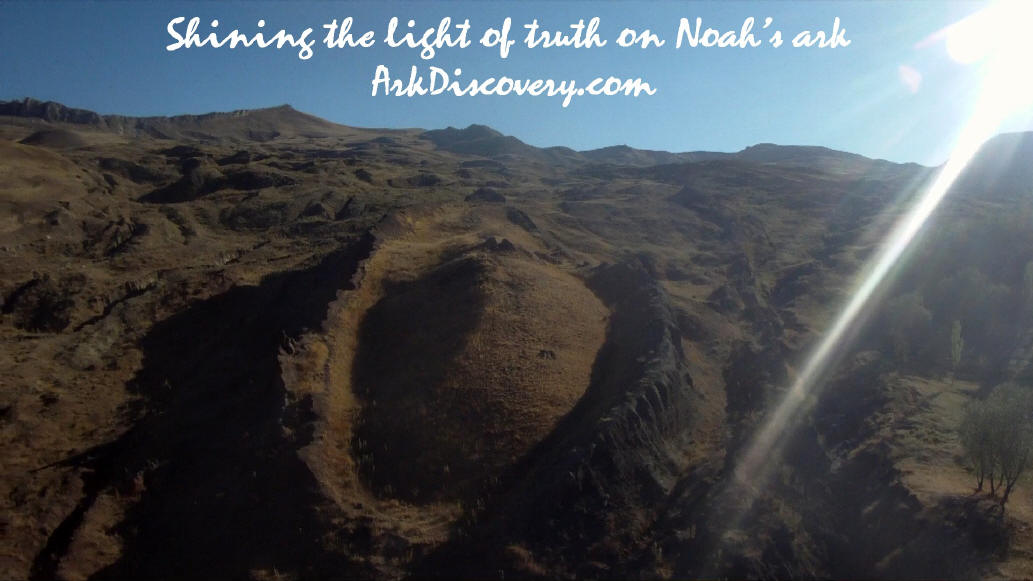
The Biblical Location
There is only one verse in the Bible which gives us a hint of where we the ark came to rest, "the ark rested...upon the mountains of Ararat." Genesis 8:4. Where is Ararat? The name Ararat is a large area or ancient country covering eastern Turkey, western Iran and western Russia, as shown in yellow below.

"The name Ararat, as it appears in the Bible, is the Hebrew equivalent of ...Urartu, ancient country of southwest Asia...mentioned in Assyrian sources from the early 13th century BC" Encyclopaedia Britanica 15th ed. Some have mistakenly assumed the Bible meant the ark came to rest on Mount Ararat (Agri Dagh), but that is not the case. Mount Ararat is 17,000 feet tall, and is a post-Flood volcanic mountain that gained its height after the Flood, therefore there is no reason to assume it is a more likely candidate for the resting place of the ark, instead it is a less likely candidate. The ark came to rest in the mountains of the ancient country of Urartu, not on Mt. Ararat.
The Ancient Historical Record
Flavius Josephus, c. 90 AD, the famous Jewish historian stated, "Its remains are shown there by the inhabitants to this day." He quotes Berosus the Chaldean, c. 290 BC, who indicated tourists would take home pieces of the ark for making good-luck charms, "It is said there is still some part of this ship in Armenia, at the mountain of the Cordyaeans; and that some people carry off pieces of the bitumen, which they take away, and use chiefly as amulets for the averting of mischiefs." These comments tend to indicate its location would not be in an inaccessible area. At some point, the ark was covered by a mud and lava flow which caused future generations to lose its location.
Life Magazine 1960


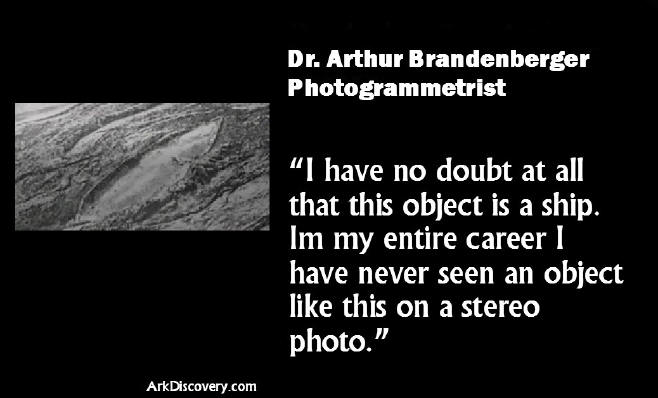
The 1960 expedition to the ark found a formation whose top sides were even with ground level as seen in the photos above. The site researched by Ron Wyatt is 18.2 miles south of Mount Ararat at the elevation of 6,524 ft., in the "mountains of Ararat." A Turkish captain, Llhan Durupinar, was reviewing NATO Geodetic Survey photographs of the area in 1959, and noticed a boat shaped formation. Others in the U.S. then analyzed the photograph including Dr. Arthur J. Brandenberger, world famous expert in photogrammetry, who said "I have no doubt at all that this object is a ship. In my entire career I have never seen an object like this on a stereo photo. Even the approximate length of the object fits" The Ark File, p118. An expedition sponsored by a party from the U.S. included among others, Rene Noorbergen, later author of The Ark File; and George Vandeman, evangelist, and Dr. Brandenberger. They made a visual inspection of the site and conducted no scientific studies, only some digging and dynamiting of the ark and and mistakenly concluded this site was just an "odd geological formation." The expedition was expecting to find on the surface of the ark "petrified beams" The Ark File, p126, by digging in a few places. An article then appeared in the September 5th, 1960, Life magazine, shown above, revealing a very impressive aerial photo of an extremely large boat-shaped object, plus two photos taken by the expedition. Seventeen years later in 1977, Mr. Wyatt made his first of 24 trips to the ark, and he was impressed that this really was the remains of Noah's Ark! In the research he performed over the next 15 years, Mr. Wyatt successfully performed metal detection tests and subsurface radar scans of the site,
and he proved this site really IS the mud-and-lava covered remains of Noah's Ark!
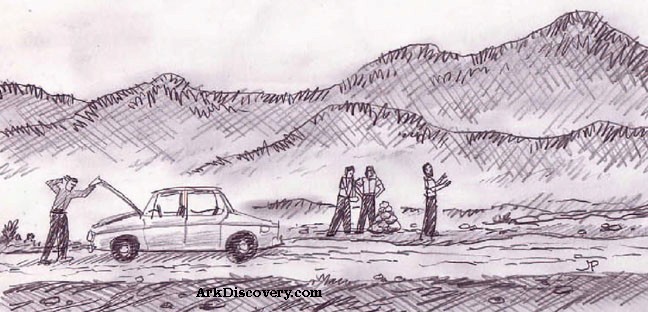
Above: Ron Wyatt in 1977 wanted to visit the area to find the ark, but none of the 1960 group could tell him where it was located, just some where near Mt. Ararat. Ron had three days in the area, so he and his two sons prayed that the Lord would help them. They hired a taxi and started driving around, then the taxi stalled. They were surprised, and quickly piled up stones to mark the spot. The car then started and they drove off. This happened three times. The next day Ron went back to the piles of stones and walked out from them. He found the ark, the anchor stones that you will see, and the remains of Noah's house. God had performed miracles to partner with Ron in revealing this amazing discovery.
click here and then click subscribe
Government Confirmation:
Visitors' Center Opened

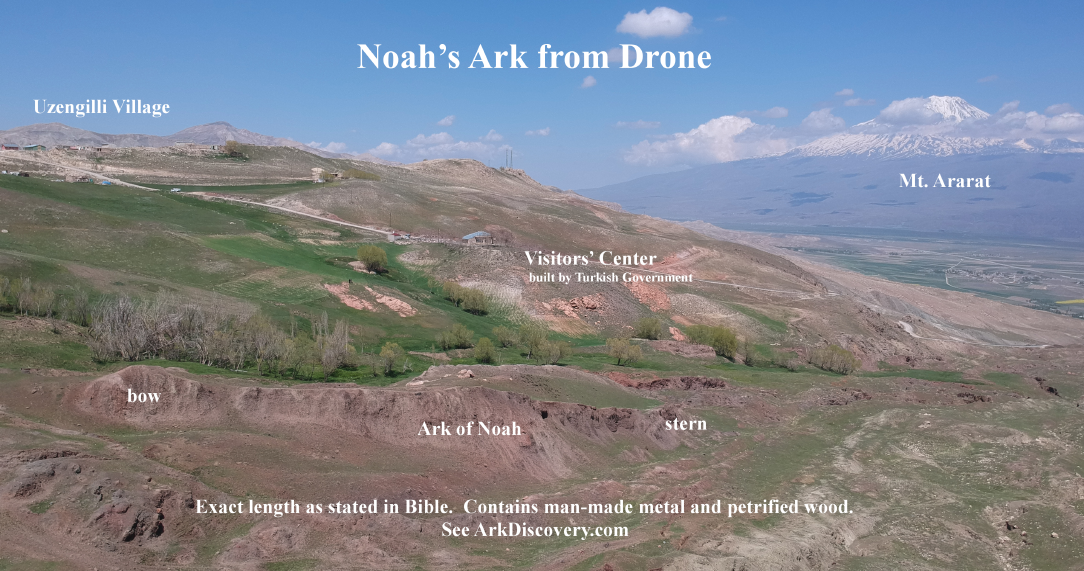
The Turkish government has double-verified Mr. Wyatt's tests, and they have given him credit for the discovery. The announcement appeared in Turkey's largest newspaper on June 21, 1987. The area was first designated a National Park, and then it was upgraded to the status of a National Treasure. The government has built a visitors' center overlooking the site and issued official tourist brochures so people of all races can come and see the ark!

Above: Visitors' Center, overlooks the ark site which is to the left. photo Kevin Fisher

Above: Inside the Visitors' Center at Noah's Ark National Park.


Translation of newspaper article announcing the discovery of Noah's Ark:
"THE NOAH'S ARK OPENED TO TOURISM. The surrounding area of a ship-like soil pile nearby the village of Uzengili within the township of Dogubeyazit as a national park. Dogubeyazit - The American Academics confirmed the soil pile nearby the village of Uzengili in the township of Dogubeyazit is Noah's Ark. The surrounding area is declared to be a national park and it is opened to tourism. 15 Km away from Dogubeyazit at the village of Uzengili, Ronal Eldon Wyatt and his colleagues, an American research group, made researches after their Turkish colleagues completed their investigations. Upon analyzing the soil structure and finding specific iron pieces and particles, the American researchers concluded that Noah's Ark is located at Uzengili village. With a ceremony attended by the Governor of Agri Province, Subgovernor of Dogubeyazit township, the Mayor Usha, Mr. Osman Baydar and the local and foreign scientists and researchers and a group of citizens, the Noah's Ark is opened to touristic visits. The Governor Serket Ekinci said, "In recent years, Turkey has become one of the countries to be visited in worldwide tourism. It is assured that the Noah's Ark, mentioned in Quran and the Bible, is located here. I am honored to pen this area having the Noah's Ark which attracts attentions of millions in the world. I owe our thanks to those national and foreign scientists and researchers contributed to the researches so as to locate Noah's Ark. At the social facilities to be built, we will accommodate local and foreign tourists and have our country make hard currency." translation courtesy Val Smith www.throneofgod.com

Government sign directs your way to the ark
Kevin Fisher standing in the "Valley of Eight" along the main highway, this government sign points your way to "Noah's Big Boat" and away from the infamous Mt. Ararat. The ark rests in the direction of the sign, up on "Doomsday Mountain" 5 Km up the mountain rests Noah's pride and joy.

Above: Using our zoom lens from the road in the valley, we can see the ark at left and the
visitors' center roof at right. In the distance is the guard tower at border with Iran. photo Kevin Fisher
visitors' center roof at right. In the distance is the guard tower at border with Iran. photo Kevin Fisher
The Length Matches the Biblical Record!

Noah's Ark at 515 feet compared to the U.S.S. Kitty Hawk aircraft carrier. Graphics Mark Johnson ArkFind.com
The length of the ruins of the ark is 515 ft., which is exactly 300 Egyptian cubits (20.6 inches)! Moses was schooled in Egypt and was not familiar with the Hebrew cubit which was not even in existence when Moses wrote Genesis. So the Egyptian cubit was used by Moses when describing the measurements of the ark.

The brown material above represents the outline and shape of the ark today. The Bible said there were three levels, and based upon the present depth of the ark, it may have originally appeared as shown above. (diagram courtesy anchorstone.com)
Watch our drone video from Noah's Ark October 2017, click here
Ark Excavated by God

Pre-earthquake photo
The photo above shows the ark deeply embedded in the surrounding terrain. In 1978, when Mr. Wyatt was returning to Nashville, he prayed that God would send an earthquake to "excavate" the site. When arriving in Nashville the headlines read, "Earthquake in Eastern Turkey." The earth dropped from around the sides of the ark, defining the formation more clearly and making it more accessible for research.

Above: We can see how the earth has dropped around the sides of the ark. photo Kevin Fisher
Metal Used in the Ark!
The ark contains a large amount of metal fittings which were used to secure the large timbers together. These two photos below are from our October 2000, trip to the site. Notice how there was once two large rivet fasteners, but now only one is left. A large metal plate was positioned behind the rivets. I received a positive metal reading when passing the metal detector over the rivets. We should not be surprised to find metal alloys used in the ark, because Genesis 4:22 states, "Tubal-Cain, an instructor of every craftsman in bronze and iron." photos Kevin Fisher


(Left) Ron Wyatt found a beautiful specimen of one of the metal rivets used on the ark. It was tested and found to contain high-tech metal alloys, such as titanium, magnesium, and aluminum, etc. Critics have said Ron did not find this fine specimen on the ark but just manufactured it. Well, as you will see below, we found the same objects and had them tested. They too proved to have the same metals, in the same percentages!
Two round, rough rivets in lower portion of photo which look similar to what Mr. Wyatt found. photo Kevin Fisher

Our Own Metal Samples Tested
Lab Report Shows
Our Rivet Contains Man-Made Metals!
Our Rivet Contains Man-Made Metals!
Exciting envelope arrives from Galbraith Labs bearing great news about the testing done on samples from Noah's ark.

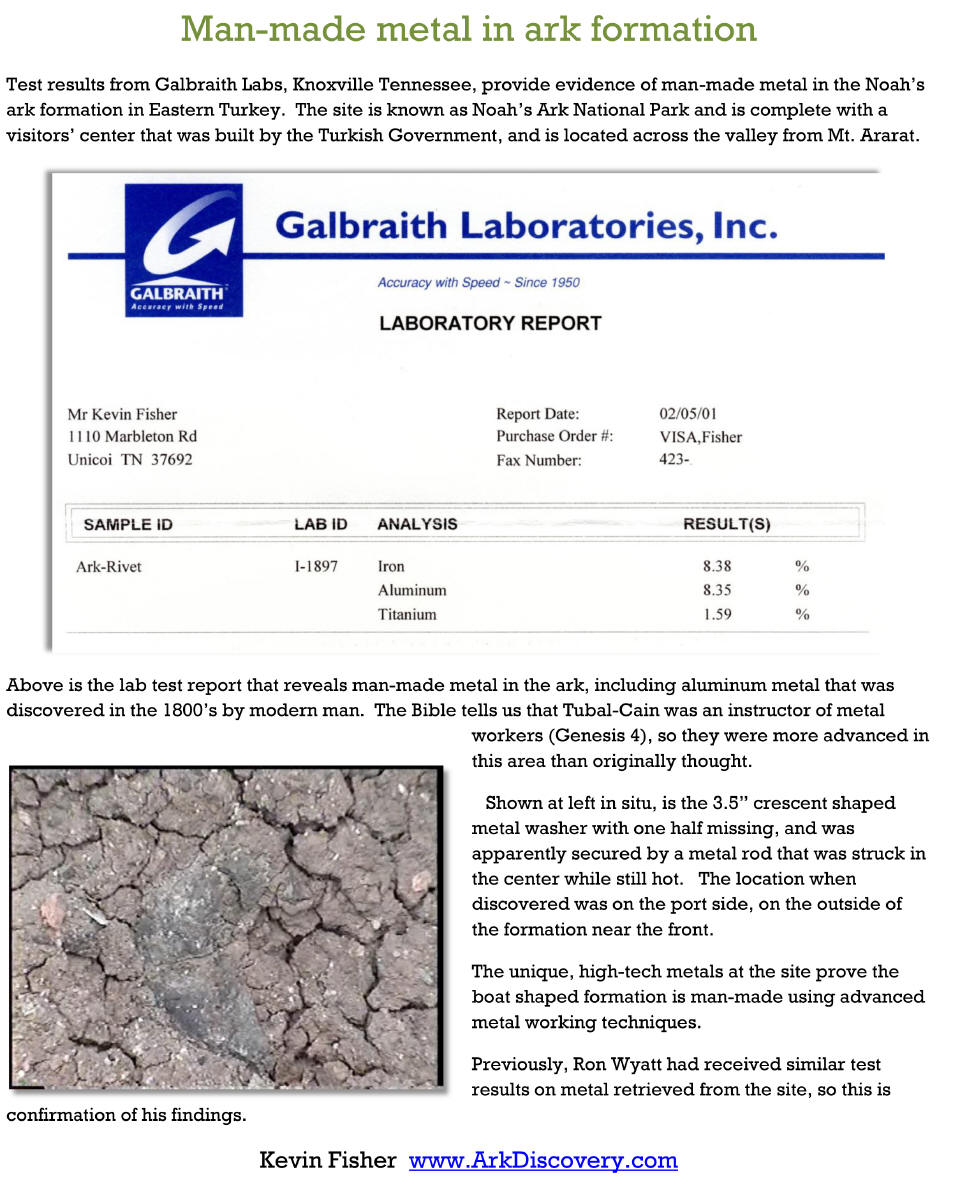
Below is what is shown above. It appears to be part of a large washer that would have been slipped over a shaft and then secured on the shaft by flaring out the end of the shaft. We have drawn circles on the photo to demonstrate the circular effect in the specimen. The surrounding material on the side of the ark around this object had a greenish color. Assuming a circular shape, this sample would be the same size as the rivet found by Mr. Wyatt. (The photo at right is of the rivet as we found it on the ark)


Galbraith Laboratories of Knoxville Tennessee has tested the specimen for three metals I requested. I asked them to test for aluminum metal, iron metal, and titanium metal. It costs $60 to test for each metal requested. The results show 8.35 % iron metal, 8.35% aluminum metal, and 1.59% titanium metal. ALUMINUM AND TITANIUM METALS ARE NOT FOUND IN NATURE!!! THIS OBJECT IS MAN-MADE, USING ADVANCED TECHNOLOGY!! These results are similar to those produced in the analysis of the rivet found by Mr. Wyatt. Since the specimen is fossilized, it is assumed a large portion of it is now silica replacement, reducing the percentage of metal that was originally in it when it was made. These rivets are found in several locations on the outside of the Ark, and are probably buried inside the Ark by the hundreds or thousands. In comparison to others, this specimen is in poor condition.
Second specimen is also man-made
with aluminum metal!
with aluminum metal!
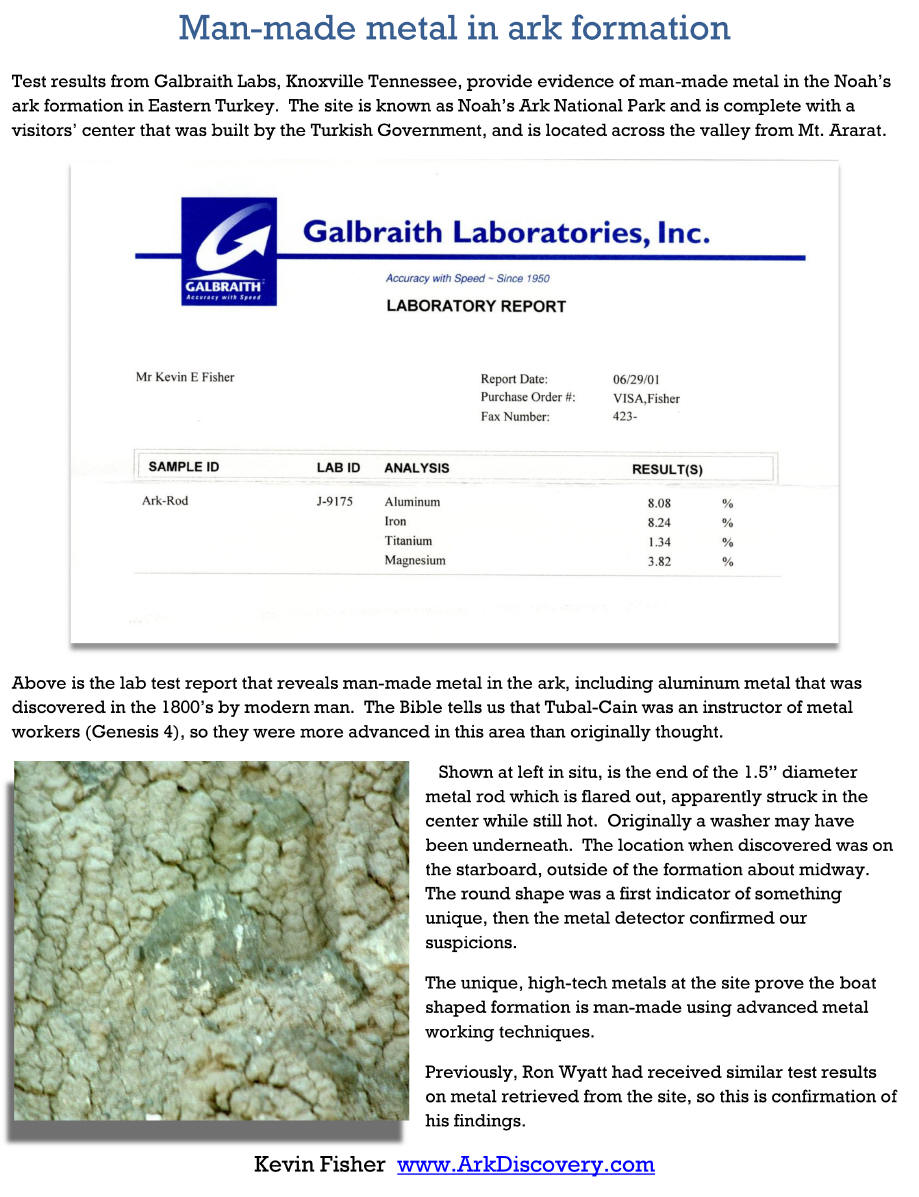
The second item I had tested by the lab reveals that is is also man-made. It was found on the side of the ark. It produced positive metal readings with my metal detector when I was at the site. Later in Istanbul, I tested it with a magnet which produced an attraction to it. It appears to have been flared out (left photo) by pounding the center when it was hot. The left hand photo is facing us the way it appeared on the starboard side of the Ark. Notice the side view (right view) which shows the tapering effect. Test results from Galbraith Labs, completed in June 2001, reveal it has man-made aluminum metal in it! It contains 8.08 percent aluminum metal, 8.24 percent iron metal, 1.34 percent titanium metal, and 3.82 percent magnesium metal. Click on link below to read lab report.


Metal Bracket
In May, 1985, Dr. John Baumgardner of Los Alomas Labs, was inspecting the ark with a metal detector when he became startled and said, "Undecomposed Iron!" A rectangular beam was protruding from the side of the ark, with iron flakes. He found a beautiful right angled wrought iron bracket which had been stretched and hammered, showing preferential gradiance. John tested it at Los Alomas Labs and it was found to be 91.84% iron FE203.
Ballast?
Below is a piece of metal ballast that may have been thrown into the bottom of the ark when the craftsmen were through forming metal brackets and had metal waste left over. Notice the concave features on almost every side, where other pieces of ballast were pressed against it when it was still hot. I found this next to the ark. XRF testing shows that it contains titanium metal and iron metal among other metals. (Two photos of same item.)


Possible Metal Wedge?
This appears to be some manganese ballast which was poured into the hull in a liquid state,
then hardened and took the curvature of the hull (right photo). It has a coating on the convex side, while the flat side appears to be metal. Found a few feet away from the ark.
then hardened and took the curvature of the hull (right photo). It has a coating on the convex side, while the flat side appears to be metal. Found a few feet away from the ark.


Ballast Found by Wyatt
This is an example of the metal ballast that has been found
in the hull of the ark. It is made up of
manganese primarily, which is a by-product of forming magnesium that was used
in the metal rivets. Found by Ron Wyatt.
Square Object with "X" Impression
The western side of the ark had this square object that had the appearance of metal on its top and three sides.. It also contained an impression in it, much like it had been struck while it was hot. It was at a higher level where I could not measure it. It may have been 8 inches in diameter. photo Kevin Fisher

In London, Texas a metal hammer was found in rock. This would be a pre-Flood, metal object:
http://184.154.224.5/~creatio1/index.php?option=com_content&task=view&id=26
http://184.154.224.5/~creatio1/index.php?option=com_content&task=view&id=26
Pre-Flood metal bell, found in West Virginia coal:
http://www.genesispark.com/exhibits/evidence/paleontological/artifacts/bell/
http://www.genesispark.com/exhibits/evidence/paleontological/artifacts/bell/
______________________________________________________________________________________________
Scans Show Man-Made Features!
New, 2016, high resolution, resistivity scans were done on the contents of the
ark and they confirm the scans done by the late Ron Wyatt in the 1980's.
see: www.noahsarkscans.nz
ark and they confirm the scans done by the late Ron Wyatt in the 1980's.
see: www.noahsarkscans.nz
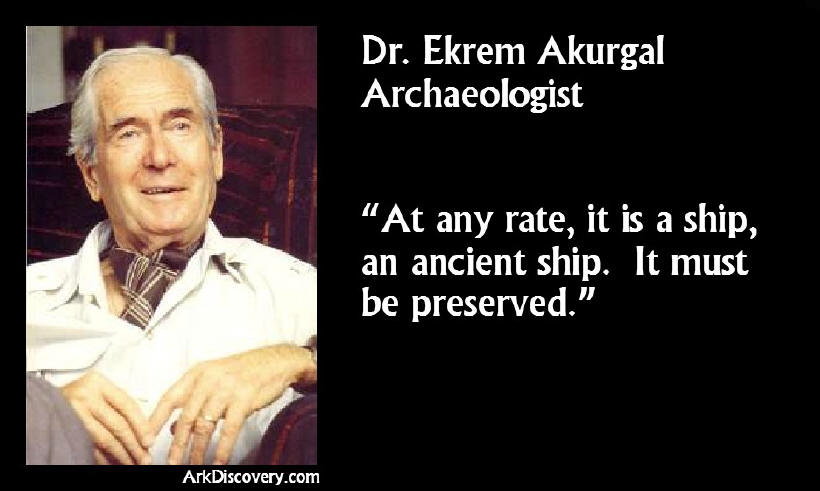
Turkey's renowned archaeologist stated:
Vertical Rib Timbers on the Sides
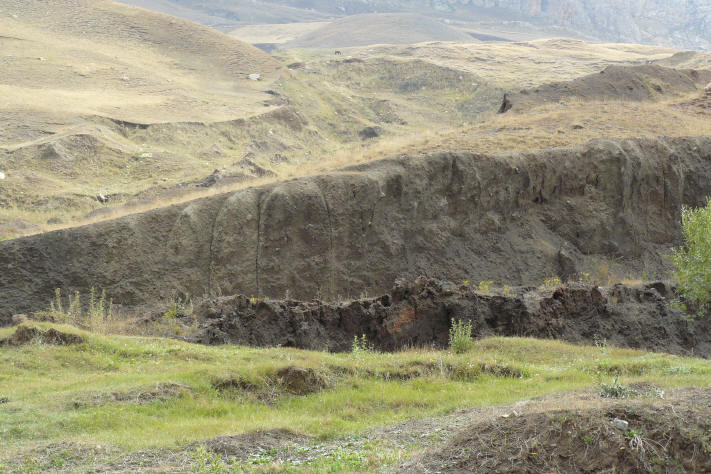
Above: On the left are some of the vertical rib timbers on the outside of the ark. photo Kevin Fisher
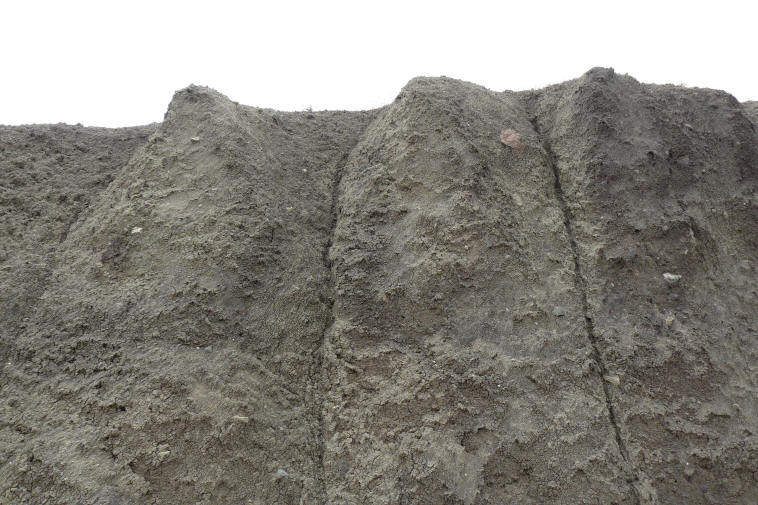
Above: A close-up shot of the petrified timbers, on western, starboard side. photo Kevin Fisher
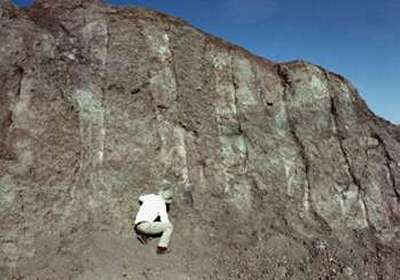
The port or eastern side of the ark, near the front, was scraped off by Ron in an effort to view the timbers without loose, crumbling material in the way. This process revealed the lighter colored rib timbers in a systematic, vertical pattern. You can see a darker, curved pattern across the top, which represents the remnants of a large keelson. (photo courtesy anchorstone.com)
Deck Posts
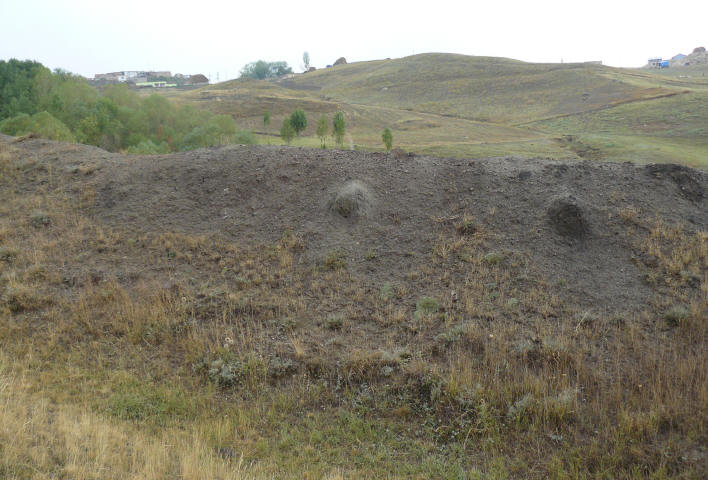
Above: Standing on the ark, we see the western, starboard, inside of the ark, which boasts these horizontal deck support posts extending above the matrix material in the center and right portions of this photo. photo Kevin Fisher
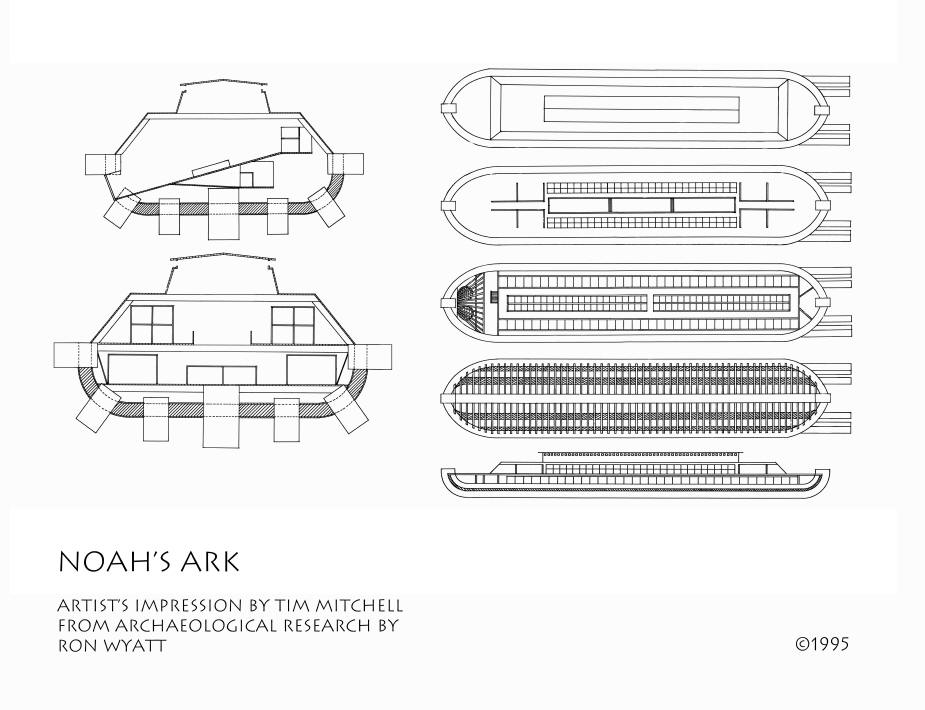
Above: Diagram of the ark based upon radar scans
Convex Symmetrical Deck
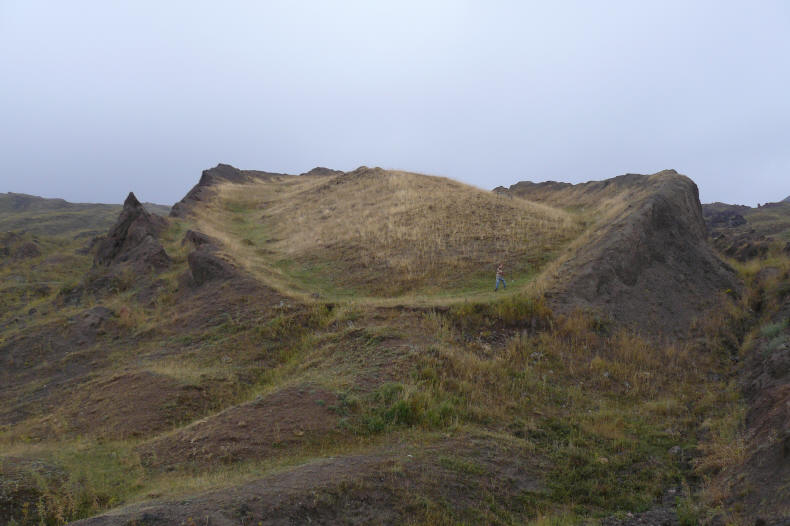
Above: The symmetrical shape of the ark can been seen from the rear, with a center mound that is the deck area that has collapsed, and the port and starboard side to the left and right. A boy can be seen at the rear. photo Kevin Fisher
The Petrified Wood
Below, this example of the petrified wood shows distinct right angles and the wood grain of the wood. Specimen found by Ron Wyatt.
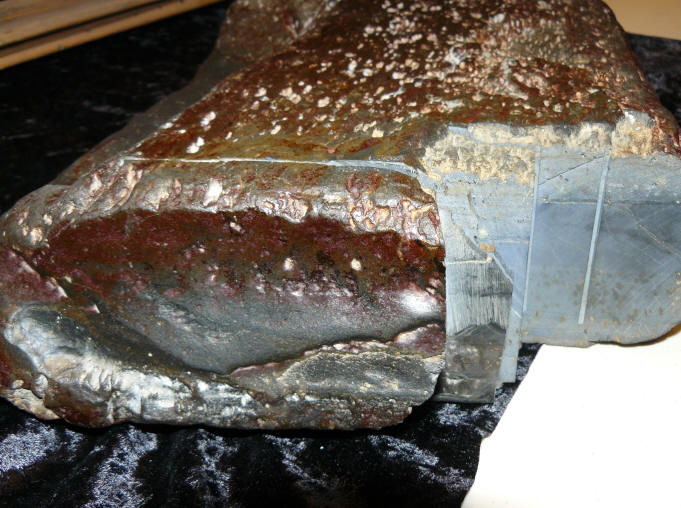
Above: A close-up photo of an 18 inch deck plank unearthed before Turkish officials by Ron Wyatt and features three distinct layers of wood with glue protruding from the end. It was tested and proved to be petrified wood. It is 18 inches in length and has a few visible nails. It is made of three layers of wood with dark pitch on top. At the bottom right you can see dark spots which may be consistent with Pecky Cypress wood, so this may be the gopher wood described in the biblical account. This deck timber was analyzed at Galbraith Labs in Knoxville, Tennessee, and was found to have a total carbon content of 0.7100%. From this figure you would deduct the inorganic carbon of 0.0081%, leaving 0.7019% organic carbon, which is a much higher level of organic carbon than inorganic, so this indicates this was once living matter. photo Kevin Fisher
Original Location
